Research creates 4x strength metals from nanoparticles
Engineering360 News Desk | February 22, 2021"Hammering and other hardening methods are all top-down ways of altering grain structure, and it's very hard to control the grain size you end up with," said Ou Chen, an assistant professor of chemistry at Brown and corresponding author of the new research. "What we've done is create nanoparticle building blocks 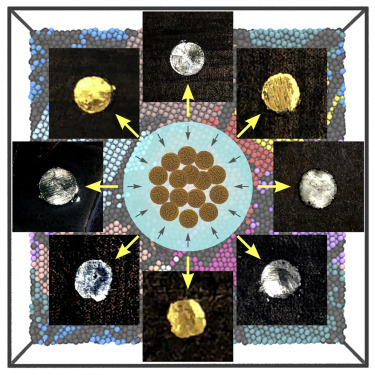 Source: Ou Chen et al.that fuse together when you squeeze them. This way we can have uniform grain sizes that can be precisely tuned for enhanced properties."
For this study, the researchers made centimeter-scale "coins" using nanoparticles of gold, silver, palladium and other metals. Items of this size could be useful for making high-performance coating materials, electrodes or thermoelectric generators (devices that convert heat fluxes into electricity). But the researchers think the process could easily be scaled up to make super-hard metal coatings or larger industrial components.
The key to the process is the chemical treatment given to the nanoparticle building blocks. Metal nanoparticles are typically covered with organic molecules called ligands, which generally prevent the formation of metal-metal bonds between particles. Chen and his team found a way to strip those ligands away chemically, allowing the clusters to fuse together with just a bit of pressure.
The metal coins made with the technique were substantially harder than standard metal, the research showed. The gold coins, for example, were two to four times harder than normal. Other properties like electrical conduction and light reflectance were virtually identical to standard metals, the researchers found.
"Because of what's known as the plasmonic effect, gold nanoparticles are actually purplish-black in color," Chen said. "But when we applied pressure, we see these purplish clusters suddenly turn to a bright gold color. That's one of the ways we knew we had actually formed bulk gold."
According to the researchers, the technique could be used to make any kind of metal. In fact, Chen and his team showed that they could make an exotic form of metal known as a metallic glass. Metallic glasses are amorphous, meaning they lack the regularly repeating crystalline structure of normal metals. That gives rise to remarkable properties. Metallic glasses are more easily molded than traditional metals, can be much stronger and more crack-resistant, and exhibit superconductivity at low temperatures.
Chen says he's hopeful that the technique could one day be widely used for commercial products. The chemical treatment used on the nanoclusters is fairly simple, and the pressures used to squeeze them together are well within the range of standard industrial equipment. Chen has patented the technique and hopes to continue studying it.