
Creating a Metal as Strong as Captain America’s Shield
Peter Brown | November 01, 2018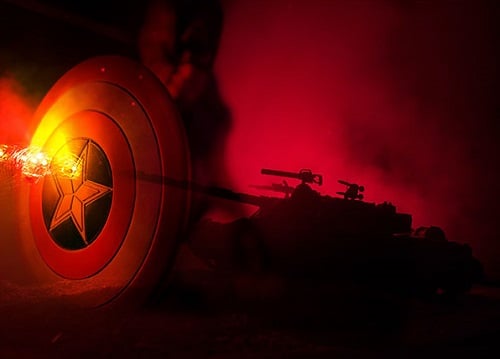 The copper and tantalum alloy could be used for military vehicles, spacecraft, buildings and more. Source: Army Research LabIn the Marvel Cinematic Universe, Captain America’s famous shield is made from the fictional material vibranium - one of the strongest, rarest metals on the planet - which can absorb, store and release kinetic energy in a controlled manner.
Of course, vibranium is purely fictional. However, research from the U.S. Army Research Laboratory and Arizona State University are pretty close.
The team has designed a super-strong alloy of copper and tantalum which can withstand extreme impact and temperature. The alloy has a structure and deformation response that makes it a good candidate for ballistic protection applications for military vehicles or personal protection for soldiers, researchers said.
But its uses could go beyond the military, as the alloy has potential as an alternative metal for structures or other items made from iron or aluminum, including future spacecraft for deep space exploration.
Researchers said the methodology for creating the alloy could be applied to other materials as well, such as nickel or iron, to develop more resilient transportation and sustainable infrastructures.
Better Absorption
When subjected to extreme impact or temperature, most metals lose the ability to deform in a ductile way and become brittle, absorbing little energy prior to fracture or failure. The possibility of better stability and absorption led researchers to create the nanocrystalline alloy of copper and tantalum, with a consistent level of mechanical strength and microstructure stability.
"The technical challenge was to make a material with an average grain size of about 50 nanometers (billionths of a meter) and remain stable when formed into usable parts or shapes," said Kiran Solanki, an associate professor in the Ira A. Fulton Schools of Engineering at Arizona State University.
The alloy creates distinct nanoclusters of tantalum, and as temperature increases the nanoclusters don’t change in size or spacing. This doubles the material’s strength and stability, also making it immune to the deformation response.
Researchers said the alloy withstands high rates of impact and temperatures in excess of 80% of its melting point - higher than 1,070 K - with little change in its microstructure.
The copper-tantalum alloy was originally developed to replace beryllium copper, a metal alloy known for its strength, conductivity, hardness and corrosion resistance, which is used in a range of applications. However, handling, manufacturing and machining of beryllium can cause a serious lung condition called chronic beryllium disease, and the alloy is a known carcinogen. The new alloy would make a viable, safer alternative, researchers said.
The full research can be found in the journal Nature Communications.
Tantalum is the rarest metal on Earth and listed as a conflict resource, can't see this going anywhere really.
In reply to #1
Tantalum is not the rarest metal on Earth. Not even close. The list of metals more rare than tantalum on Earth include: francium, ruthenium, rhodium, iridium, osmium, rhenium, platinum, paladium, gold, silver, indium, mercury, and tungsten. That isn't even including the strictly man made elements.
Apparently it has already been to the places you never thought it could go.
In reply to #4
I do stand corrected (mixed up Tantalum and Palladium actually). Apologies.
It still is a conflict mineral, though.
In reply to #5
The ability to graciously accept criticism is a laudable trait. Kudos.
In your most recent reply, you are almost correct. Tantalite/columbite the ore from which tantalum is refined is considered a conflict mineral. Tantalum itself does not occur naturally in sufficient quantities as the metal to be mined AFAIK. A mineral must be naturally occurring and since tantalum itself is not being mined to fund conflict, neither side of that lable applies.
If you are concerned about your own contribution to conflicts related to tantalum demand, you may find these two facts worth mulling over:
1. Around 1% of global annual tantalum supply comes from ore in areas where it could be involved as a conflict resource.
2. Claiming tantalum use is widespread is an understatement. Use of tantatum capacitors in anything that might be considered hugh tech is close to ubiquitous. It would be difficult for you to make comments on this blog about eschewing the use of tantalum as a vonflict resource without involving equipement several times that relies on components that as manufactured with tantalum.
In reply to #6
* Use of tantatum capacitors in anything that might be considered high tech is close to ubiquitous. It would be difficult for you to make comments on this blog about eschewing the use of tantalum as a conflict resource without involving equipement several times that relies on components that are manufactured with tantalum.
I never understood why the NSA allows American companies to publicize research for new technologies, especially those intended for military applications -- Isn't this up there on the list with other national security issues? Just curious.
Interesting thought
Ever heard of disinformation?