Fern Inspires Breakthrough Electrode Design
Nancy Ordman | July 06, 2017What do a fern native to the western United States and fractal geometry have in common with solar energy? Quite a lot: the fractal nature of the fern’s structure inspired a new electrode design that, in turn, could increase energy storage capacity by 3,000 percent.
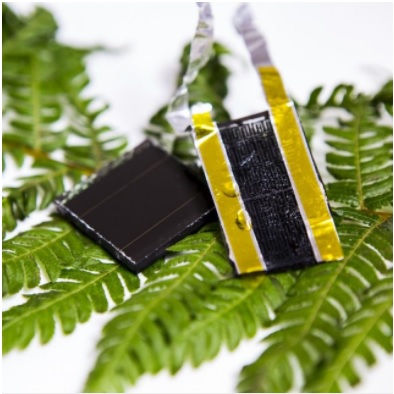 The breakthrough electrode prototype (right) can be combined with a solar cell (left) for on-chip energy harvesting and storage. (Source: RMIT)
The prototype electrode, developed at the Royal Melbourne Institute of Technology, is designed to work with supercapacitors. Supercapacitors charge and discharge energy faster than conventional batteries, but their storage capacity is limited. Increasing their storage potential would represent a major breakthrough for solar energy proponents.
The western swordfern (Polystichum munitum) has an extensive network of veins in its fronds, using the space as efficiently as possible. The fern’s venous network is fractal — composed of self-repeating patterns.
“The leaves of the western swordfern are densely crammed with veins, making them extremely efficient for storing energy and transporting water around the plant,” said RMIT Professor Min Gu. Using the fern’s fractal network design, the prototype electrode maximizes its energy storage potential.
The new electrode is graphene-based and used on flexible thin-film technology. Lead author Litty Thekkekara pointed out that the technology makes the electrode suitable for many applications. “The most exciting possibility is using this electrode with a solar cell, to provide a total on-chip energy harvesting and storage solution,” Thekkekara said.
Other applications range from cell phones to hybrid cars and other technologies that depend on battery power to work. Thekkekara and Gu will now move on to integrating the prototype into solar cells to evaluate performance.