Sensitive Hydrogen Sensor Uses Hafnium
S. Himmelstein | June 07, 2017Hydrogen’s promise as a clean energy carrier is tempered by its combustibility and difficulty encountered in detecting leaks. One option for detecting hydrogen is the use of optical sensors based on a gold-palladium alloy. While this alloy has the advantage of working at room temperature, it is unable to detect low hydrogen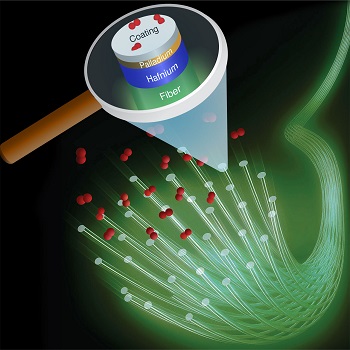 Operating temperature limitations can be solved by placing a thin layer of hafnium on top of an optical fiber and heating it with a warm-up LED. (Source: Delft University of Technology) pressures.
European researchers have discovered that hafnium does have this sensitivity. The material can optically measure a minimum of six orders of magnitude in pressure. The lowest pressure measured is 10-7 atmosphere, which is determined by the measurement set-up. A pressure of three orders of magnitude lower could be measured with hafnium, but more research is needed to confirm this.
The optical properties of hafnium change linearly with the pressure and temperature of the material, making hafnium sensors very easy to calibrate.
The hafnium-based hydrogen sensor works best at a temperature of around 120 degrees Celsius (248 F), a limitation which may be solved by placing a thin layer of hafnium on top of an optical fiber and then heating it with a warm-up LED.
Scientists from Delft University of Technology (the Netherlands), KU Leuven (Belgium) and the Rutherford Appleton Laboratory (U.K.) participated in this research.