Microchip Improves Circulating Tumor Cell Diagnostics
S. Himmelstein | June 06, 2017Detection and classification of circulating tumor cells (CTCs) is an emerging method for screening for multiple types of cancer. Fluorescence-activated cell sorting (FACS) is one such method but is limited as test results cannot be narrowed down to a single cell because the collection vessel contains thousands of cells.
A microchip that works with individual cells has been developed at the Fraunhofer Institute for Biomedical Engineering, Germany. Single cells are placed in separate holes, analyzed, and pushed onward to make space for other cells. The array has approximately 200,000 holes with a slight negative air pressure to hold the cells in place, allowing a relatively large sample of cells to be assayed. Previous lab-on-chip technologies cannot accommodate more than 1,000 cells, which is too few for this kind of application. 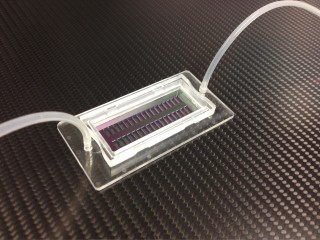 The new microhole chip can be populated with 200,000 single cells, each held in place in separate holes. (© Photo Fraunhofer IBMT)
A two-step cell analysis method was applied in a collaborative research project on CTC identification. In the first step, suspicious-looking cells were selected using a microscope. In the second step, the selected cells underwent detailed analysis using the more time-intensive method of Raman spectroscopy which involves exposing the cells to light in a defined frequency range. Tumor cells scatter light in a specific way that allows them to be clearly identified. Raman spectroscopy cannot be used on conventional arrays with a glass or polymer substrate, because these materials interfere with the measurement – but this is not an issue for the new chip and its silicon-nitride substrate.
Other possible applications envisioned for the new microhole chip include as a selection system for protein-producing cells, such as those required to make insulin and other biopharmaceuticals. Microchips with well-defined micropores can be used as a substrate for in vitro modeling of physiological barriers such as the blood-brain barrier or the intestinal barrier.