Artificial Hair Sensors Could Enable “Fly by Feel”
S. Himmelstein | May 21, 2017Scientists at the U.S. Air Force Research Laboratory were inspired by the hairs on bats and crickets in the creation of artificial hair sensors that could assess the external environment and change maneuvers during flight. The need to understand ambient air data and its effects on aircraft performance, navigation, and more has become more critical as aircraft are now lighter and able to operate in diverse environments.
“Ever notice how a cricket might stop chirping when you walk into a room? It’s because it detects a big air disturbance and does not know if you are a friend or a foe,” said Dr. Jeff Baur, a principal engineer in the Structural Materials Division, Materials and Manufacturing Directorate. “Nature has given bats and crickets these fine hairs that they use to sense changes in their environment. We hypothesized that if we could engineer similar hairs at the surface of an aircraft, we could enable an agile flight system that can detect air changes and ‘fly by feel’.”
The Artificial Hair Sensor team created the sensors using carbon nanotube forests grown inside glass fiber capillaries. The hairs are sensitive to airflow changes during flight, enabling quick response by fliers. The sensors work when air flows over the fiber, compressing the carbon nanotube, causing a change in the resistance between the electrodes.
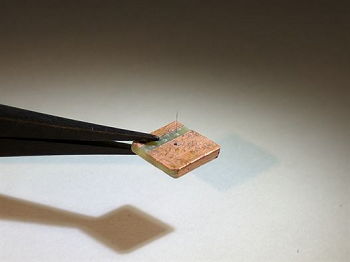 Source: U.S. Air ForceConventional aerial systems typically draw data from bulky “bolted-on” sensors, resulting in single point measurements with delayed sensing. The Artificial Hair Sensor mimics those used by natural fliers — like bats and crickets — using carbon nanotube forests grown inside glass fiber capillaries with electrodes on each end. The hairs are sensitive to air flow changes during flight, enabling quick response by fliers.
With a diameter of less than one-tenth of a human hair, the sensors work when air flows over the fiber, compressing the carbon nanotube, causing a change in the resistance between the electrodes. This information is analyzed by a “brain-like” neural network, in which an algorithm is able to process and dictate a response.
“These can help to better understand aerodynamics or wind gusts in an urban environment, for example. Imagine my agile aircraft is turning the corner of a building — the wind may change. If I have a system that can detect a gust is coming, I can adjust immediately to stay on course,” said Dr. Greg Reich, a team member from the Aerospace Systems Directorate.
Development and bench-level lab testing of the sensors was augmented by use of pressure wave tubes developed at the Munitions Directorate and wind tunnels within the Aerospace Systems Directorate to validate the sensor durability and sensitivity to speed.
“By changing the diameter of the capillary, we are able to detect different wind speeds and have shown success at up to 100 miles per hour,” said Baur. “We are still in the process of evaluating durability, but already we have tested the same sensor for more than 316 hours. This shows great promise.”
Another potential use for the artificial hair sensors is in bonded composites. By applying the sensors across bonded material, researchers can internally detect what is going on inside of a bond, which may allow them to detect a break before it happens.