Engineering Empathy in Health Professionals
S. Himmelstein | May 13, 2017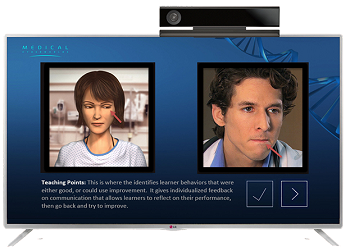 Virtual human characters promote empathic engagement with learners. Image credit: Medical Cyberworlds Inc.The ability of aspiring doctors to prepare for difficult and emotionally charged encounters with patients, such as when a cancer diagnosis must be conveyed, can improve by practicing with interactive software. University of Michigan researchers tested MPathic-VR software developed by Medical Cyberworlds Inc. and concluded that the virtual reality program is helpful in developing both verbal and non-verbal communication skills.
Poor clinician communication skills may contribute to lower levels of patient satisfaction, poorer health outcomes and higher risk of complaints and malpractice claims. Inadequate communication is consistently among the most frequently identified root causes for sentinel events in hospital settings—events that can lead to preventable patient harm or even death.
The simulation allows learners to talk with emotive, computer-based virtual humans who can see, hear and react to them in real time. The virtual humans use a full range of behaviors expected between two people talking together.
The system assesses learners’ body language, facial expressions and communication strategies, then uses this information to produce real-time responses from the virtual human and provide personalized suggestions based on the learners’ strengths or weaknesses. Learners also see their interactions with the virtual human on video, and get the chance to apply what they’ve learned.
A study was conducted among 421 students at three U.S. medical schools. Half the group used virtual reality, half used more traditional computer-based learning. The researchers say the carefully designed structure of the learning experience, including the repeat interactions, improved the students’ communication skills.
The carefully designed structure of the learning experience, including the repeat interactions, improved the students’ communication skills, the findings suggest.