
Synthetic Retina for the Blind
Abe Michelen | May 08, 2017The creation of an artificial retina has been in the research domain for many years now. To create it, the researchers had been using rigid materials, a possible inconvenience for the user. Last week, the University of Oxford, UK, announced that Vanessa Restrepo-Schild, a Dphil (the Oxford term for Ph.D) student and researcher in the department of chemistry has developed a special biological synthetic tissue that can be used to create synthetic retinas. This is a revolutionary development that can greatly impact the bionic implant industry and give big hopes to visually impaired people.
The retina sits at the back of the eye and its function is to react to light and send the information to the brain. The information sent consists on electrical signals converted by the retina when light impinges on the numerous protein cells on its surface.
Restrepo-Schild, a native of Colombia, led the development of the synthetic retina that closely resembles the functions and touch of the natural human retina. The replica is made of hydrogel (soft water droplets) and biological cell membrane proteins.
“I have always been fascinated by the human body. I want to prove that current technology can be used to replicate the function of human tissues, without having to actually use living cells,” Restrepo-Schild said.
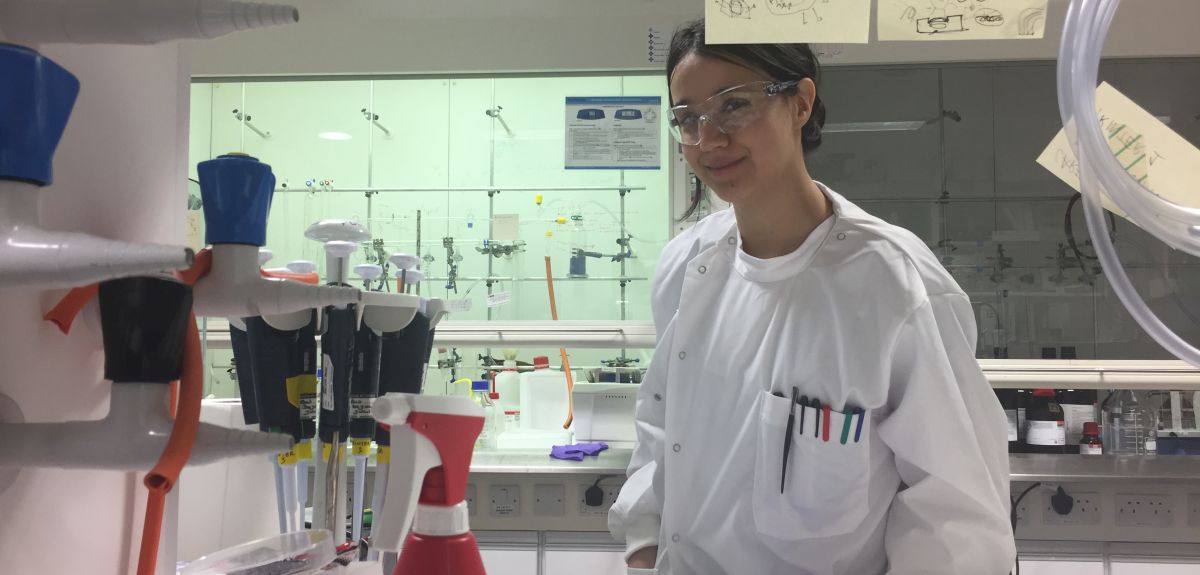 Vanessa Restrepo-Schild in her lab at the University of Oxford. Credit University of Oxford
The membrane proteins in the synthetic retina act exactly like pixels in a photographic camera. They detect light rays to create a grey scale image.
“The synthetic material can generate electrical signals, which might stimulate the neurons at the back of our eye just like the original retina,” Restrepo-Schild said.
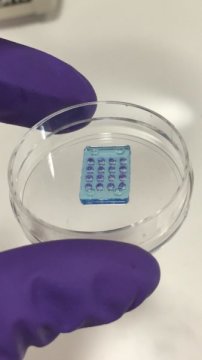 The retina replica consists of soft water droplets (hydrogels) and biological cell membrane proteins. Designed like a camera, the cells act as pixels, detecting and reacting to light to create a grey scale image. Credit: Oxford University
The most important feature of this new tissue is that the cell-cultures are created from natural, biodegradable materials, so the implanted retina is less invasive than a rigid device and it is less likely to be rejected by the body.
“The human eye is incredibly sensitive, which is why foreign bodies like metal retinal implants can be so damaging, leading to inflammation and/or scaring. But a biological synthetic implant is soft and water based, so much more friendly to the eye environment," Restrepo-Schild added.
"I have taken the principals behind vital bodily functions, e.g. our sense of hearing, touch and the ability to detect light, and replicated them in a laboratory environment with natural, synthetic components. I hope my research is the first step in a journey towards building technology that is soft and biodegradable instead of hard and wasteful.”
At present, the synthetic retina is being tested in a laboratory environment. In the near future Restrepo-Schild and the Oxford team will explore the potential uses of the living tissue in order to test if it is suitable for bionic implants. They want to see how to expand the functions of the synthetic retina to include recognition of colors, shapes and symbols. In the long term, the team expects to test the retina in animals and eventually on humans.
The research was published in the journal Scientific Reports, and can be read here in its entirely: https://www.nature.com/articles/srep46585
The eye is a masterpiece. Its neurological fabric is extraordinary, at once very sensitive and very durable.
For all the bionics coming along, 3-D bionic neurology is a candidate for the Holy Grail. The retina is good start - more like a dozen layers of micron scale circuit boards integrated with each other through at least a couple layers of ''pure'' processors refining on average about 100 million sensor signals many times per second appropriately relayed down the optic nerve. Putting all this together as a physically and functionally durable and stable bionic implant boggles the mind. I imagine quantum computing is an early entry in the process.