Watch: Nanobots Designed to Propel Through the Eye
S. Himmelstein | November 08, 2018Advances have been reported in the development of nano-scale devices to swim through the bloodstream and deliver drugs or detoxify bodily fluids. Now nanobots have been designed to penetrate dense tissue — specifically the vitreous body of the eye.
Slippery micropropellers were engineered as intravitreal delivery microvehicles that can be actively propelled through the vitreous humor to reach the retina. The propulsion is achieved by helical magnetic micropropellers 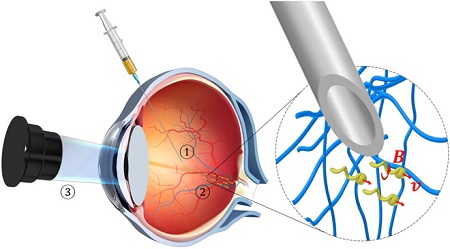 Schematic of the targeted delivery procedure used for the slippery micropropellers. Source: Science Advancesthat have a liquid layer coating to minimize adhesion and enable tissue penetration.
Targeted drug delivery inside dense biological tissue is very challenging at the nanoscale, primarily due to the viscous consistency inside of the eyeball and the tight molecular matrix through which a nanopropeller must navigate. Sizing the nanopropellers to under 500 nm and application of a two-layered non-stick coating overcomes these limitations. Precise actuation is achieved by the addition of iron, which allows users to steer the drill-bearing bots to specific targets via magnetic fields.
Using a small needle, researchers injected tens of thousands of the bacteria-sized helical robots into the vitreous humor of a dissected pig’s eye. With the help of a surrounding magnetic field that rotates the nanopropellers, movement was observed by clinical optical coherence tomography as the devices swam toward the retina.
Scientists from Max Planck Institute for Intelligent Systems (Germany), Harbin Institute of Technology (China), University of Stuttgart (Germany), Max Planck Institute for Medical Research (Germany), University Eye Hospital Tübingen (Germany) and Aarhus University (Denmark) contributed to this research, which is published in Science Advances.