A Bright Idea: Preventing Blindness with Glowing Contact Lenses
S. Himmelstein | April 24, 2018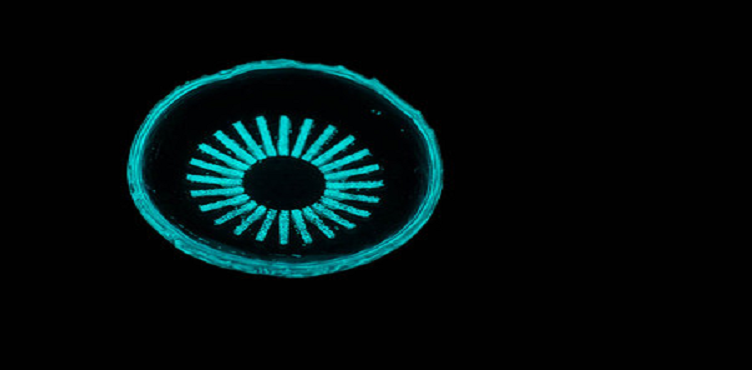 This glowing contact lens could help prevent blindness in millions of people with diabetes. Source: California Institute of Technology
The loss of vision that accompanies diabetes is the result of the damage the disease causes to tiny blood vessels. While the body will try to compensate by growing new vessels in the retina, these structures are poorly formed in diabetics and tend to bleed, obscuring vision and generating scar tissue.
Retinal damage is attributed to an insufficient oxygen supply, which is conventionally treated with lasers to burn away cells in the peripheral regions of the retina, or by injecting medication that reduces the growth of new blood vessels directly into the eyeball.
A less painful and invasive option engineered at California Institute of Technology involves use of a glow-in-the-dark contact lens. The devices reduce the metabolic demands of the retina by lowering its night-time oxygen demand. The lenses give the eye’s rod cells — which consume more oxygen in the dark than in bright light — a minimal amount of light exposure as the wearer sleeps.
The designers applied the technology used to make glowing watch faces by incorporating tiny vials of tritium into the lenses in a radial pattern, creating a circle big enough to fall outside of the wearer's view when the pupils are constricted in lighted conditions. In the dark, the pupil expands, and the faint glow from the vials can illuminate the retina.
Electrons emitted by this radioactive form of hydrogen gas as it decays are converted into light by a phosphorescent coating. This system ensures a constant light output for the lifetime of the contact lens.
Early testing of the lenses shows that rod cell activity is reduced by as much as 90 percent when worn in the dark. Trials are being planned to see if their ability to reduce retinal metabolism will translate into the prevention of diabetic retinopathy. Following those tests, the researchers will seek U.S. Food and Drug Administration permits to begin clinical trials.