Stain-resistant Textiles without Chlofluorocarbons?
Nancy Ordman | May 05, 2017A cooperative project between researchers in two departments at Cornell University has produced a greener
 Samples of cloth both untreated, left, and treated with a fluorine-free oleophobic coating. Credit: Genggeng Qi/Cornell Universitystain-repellent coating for fabrics. The researchers have submitted a patent disclosure for their discovery and received a provisional patent.
Engineers and fashion designers are collaborating more often since the advent of 3-D printing, but collaboration between a materials scientist (Emmanuel Giannelis) and a fiber scientist (Jintu Fan) are less usual. Fan approached Giannelis, initially to work on a breathable, wrinkle-resistant fabric.
When the apparel company with which the researchers were collaborating asked for an oleophobic — resistant to oil — coating, Giannelis and his graduate students took on the challenge. Conventional oil-repellant coatings contain fluorine, which breaks down over time into chlorofluorocarbon gas, a well-known greenhouse gas. A greener anti-wrinkle option would help eliminate one source of chlorofluorocarbon.
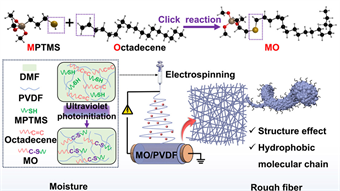
Materials science postdoctoral researcher Genggeng Qi created a fiber with a rough surface that creates air pockets. Liquids with a sufficiently high surface tension ball up, rather than spreading out and soaking through the fiber. Testing with mineral oil, which has a low surface tension, have been successful.
Fan is enthusiastic about these early test results. “We’ve found that even after 30 washings, it’s still durable, which is great,” he said. “Even if we can achieve [oleophobicity] that’s even close to fluorine-based [polymers], that would be a huge breakthrough.”