
Graphene Gives a New Lease on Millennia-old Gilding Techniques
Siobhan Treacy | September 11, 2018University of Illinois (UI) at Urbana-Champaign researchers have improved gilding, a 1,000-year-old conservation technique used by Ancient Egyptians and Chinese, with modern metals. Gilding prevents years of corrosion, wear and tear over many years, explaining why many Egyptian artifacts still look good and pure today.
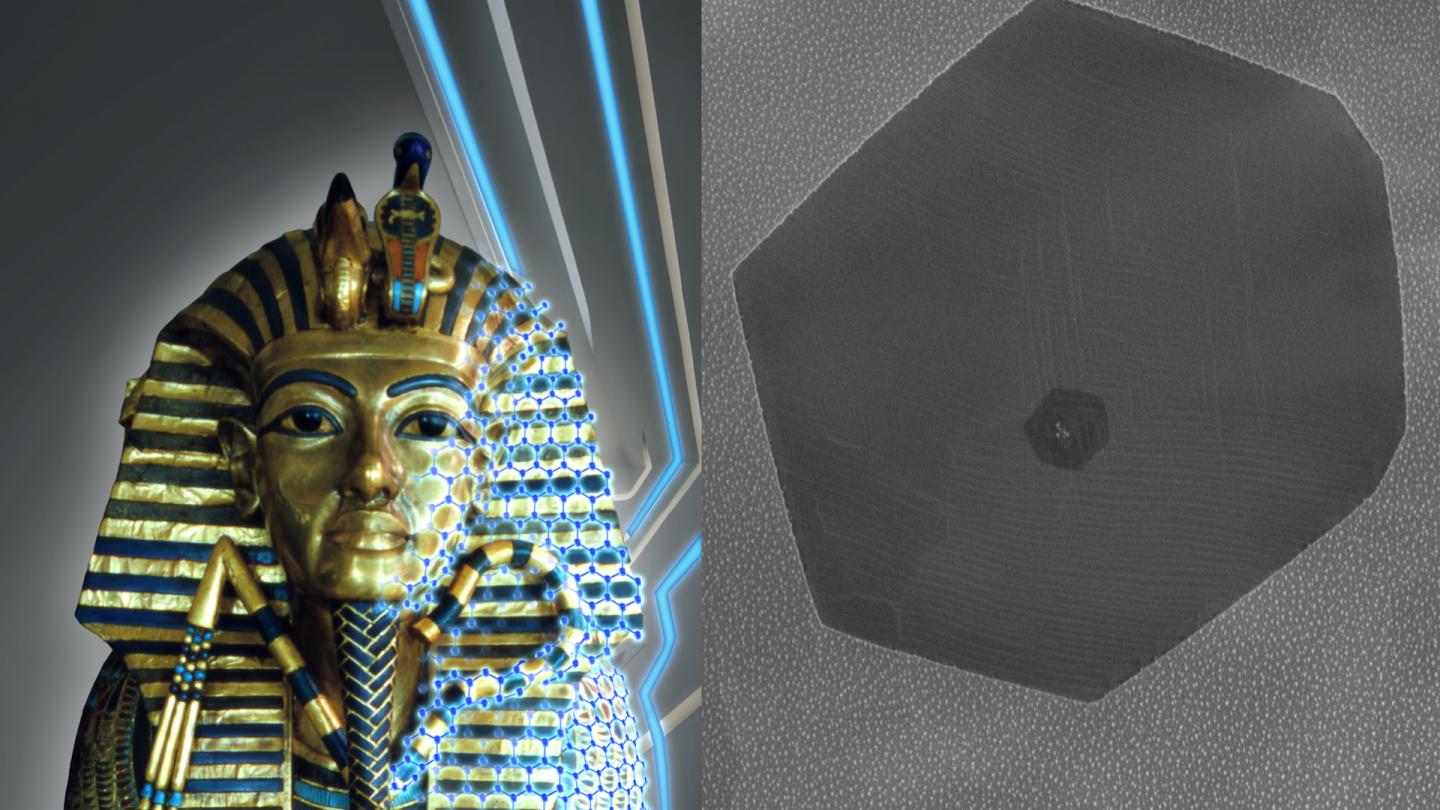 Microscope image of a graphene crystal is shown on the palladium leaf. Source: Griffith Institute, University of Oxford
The UI team has adapted the gilding technique to use today’s most promising metal, graphene. The researchers applied graphene with gilding on top of metal leaves, finding that it doubled the technique's protective properties.
The coated metal leaves, made of palladium are useful for scalable coating materials. They are commercially available in inexpensive, large rolls. The graphene-coated palladium leaves could be useful for buildings, ship hulls, metal surfaces of consumer electronics and protection of small precious artifacts or jewelry.
When the graphene bonded with palladium, it enhanced the mechanical resistance of the metal leaves along with other promising improvements.
"Adding one more layer of graphene atoms onto the palladium made it twice as resistant to indents than the bare leaves alone," said Sameh Tawfick, an assistant professor of mechanical science and engineering. "It's also very attractive from a cost perspective. The amount of graphene needed to cover the gilded structures of the Carbide & Carbon Building in Chicago, for example, would be the size of the head of a pin."
The team also created a new technology that grows high-quality graphene directly on the surface of 150 nanometer-thin palladium leaves in 30 seconds. The new technology used chemical vapor deposition to deposit the graphene on the leaf surface in a 1,100° C furnace. The leaf acts as a catalyst and the gases act quickly, resulting in a quick graphene layer.
"Chemical vapor deposition of graphene requires a very high temperature, which could melt the leaves or cause them to bead up by a process called solid state dewetting," said Kaihao Zhang, PhD candidate in MechSE and lead author of the study. "The process we developed deposits the graphene quickly enough to avoid high-temperature degradation, it's scalable, and it produces graphene of very high quality."
A paper on the updated process was published in Advanced Functional Materials.




Shouldn't the term be GILDING?
In reply to #1
I agree, gilding is a process & gliding is a verb
In reply to #2
I noticed both were used in the article. I suspect autocorrect malfunction. I plan to let this one glide by.
In reply to #3
A copy & paste job gone wrong
Thanks for catching the error. I'm not sure when it was fixed but it definitely has been taken care of.