Bringing CLARITY to Bones
S. Himmelstein | April 27, 2017In a development that could advance drug testing and therapies for osteoporosis, California Institute of Technology (Caltech) researchers rendered intact bones transparent. CLARITY, a technique originally developed at Stanford University for clearing brain tissue, was successfully demonstrated. The process enables observation of stem cells in bone marrow and their responses to new drugs.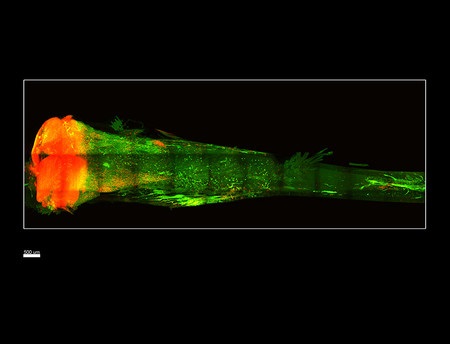 A mouse tibia that has been rendered transparent with Bone CLARITY. Stem cells appear distributed throughout the bone in red. Image credit: Science Translational Medicine, Greenbaum, Chan, et al; Gradinaru Laboratory/Caltech
The technology imparts transparency to brain and other soft tissues by removing lipids, which are opaque molecules, from cells while also providing structural support by an infusion of a clear hydrogel mesh. The Caltech team expanded the method to make all of the soft tissue in a mouse's body transparent.
The researchers next set out to develop a way to clear bone and other hard tissues, using bones from postmortem transgenic mice. These mice were genetically engineered to have their stem cells fluoresce red so that they could be easily imaged. The researchers first stripped calcium from the bones, since calcium contributes to opacity, and bone tissue has a much higher amount of calcium than soft tissues. Next, because lipids also provide tissues with structure, the team infused the bone with a hydrogel that locked cellular components like proteins and nucleic acids into place and preserved the architecture of the samples. Finally, a gentle detergent was flowed throughout the bone to wash away the lipids, leaving the bone transparent to the eye.
For imaging the cleared bones, the team built a custom light-sheet microscope for fast and high-resolution visualization that would not damage the fluorescent signal. The cleared bones revealed red fluorescing stem cells inside.
The group collaborated with researchers at the biotechnology company Amgen to use the Bone CLARITY method to test a new drug developed for treating osteoporosis. The vertebral columns of one group of mice receiving the treatment were compared with samples from a control group. The analysis confirmed that the new drug increased stem cell numbers.