Deep UV Light from LEDs
Engineering360 News Desk | April 02, 2017U.S. researchers report development of an efficient and environmentally friendly alternative to mercury-based lamps widely used to emit deep UV light for food and water disinfection and other industrial applications.
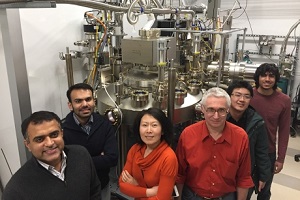 Cornell University researchers flank one of the molecular beam epitaxy systems used in their latest work. Source: Cornell UniversityCornell University, NY, and University of Notre Dame, IN, engineers designed an LED light source that produces deep-UV emission at 232 -270 nm wavelengths. Monolayers of gallium nitride and aluminum nitride were deposited using plasma-assisted molecular beam epitaxy to produce quantum structures that act as UV emitters.
The 232- nm emission represents the shortest recorded wavelength using gallium nitride as the light-emitting material, besting the previous record of 239 nm held by researchers in Japan.
The use of gallium nitride instead of conventional aluminum gallium nitride improves the internal quantum efficiency -- the proportion of all electrons in the active region that produce UV light. A gain is also observed for light extraction efficiency, or the proportion of photons generated in the active region that can be extracted from the device.