High Efficiency PV Cells Based on a Boron Nitride Separation Process
S. Himmelstein | August 31, 2018A boron nitride separation layer could hold the key to high-efficiency hybrid photovoltaic (PV) cells that can harness a broader spectrum of light. The layer was used by semiconductor researchers to grow indium gallium nitride (InGaN) solar cells that were then lifted off the original sapphire substrate and placed onto a glass substrate.
This lift-off process can be applied to combine InGaN cells with PV devices made from silicon or gallium arsenide, resulting in hybrid structures which could theoretically boost solar cell efficiency as high as 30 percent for 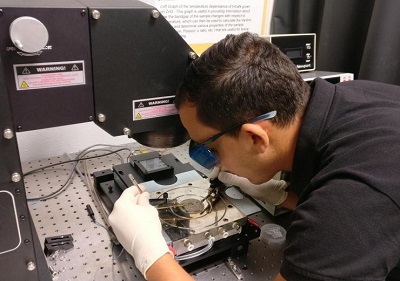 A researcher measures the photovoltaic performance of the InGaN solar cells with a solar simulator. Source: Ougazzaden Laboratory, Georgia Tech Lorrainean InGaN/Si tandem system.
A metalorganic vapor phase epitaxy process was used to grow boron nitride monolayers on two-inch sapphire wafers at approximately 1,300 C. Only a few nanometers thick, the boron nitride surface coating produces crystalline structures that have strong planar surface connections but weak vertical connections.
The InGaN attaches to the boron nitride with weak van der Waals forces, allowing the solar cells to be grown across the wafer and removed without damage. The cells are removed from the sapphire manually, but future implementation of automation technology is expected to streamline the process and reduce the cost of the hybrid cells.
The InGaN structures are then placed onto the glass substrate with a backside reflector. The arrangement improves performance, and the international research team aims to increase the amount of indium in the lift-off devices to boost light absorption and increase the number of quantum wells from five to 40 or 50, according to a news release.
Scientists from Georgia Institute of Technology, the French National Center for Scientific Research, Institut Lafayette and Georgia Tech Lorraine in Metz, France contributed to this development.