Portable Water Purification with Foil-Based LEDs
Engineering360 News Desk | November 18, 2016Lightweight, flexible metal foil-based light-emitting diodes are being developed for portable ultraviolet (UV) lights that soldiers and others can use to purify drinking water and sterilize medical equipment.
Engineers at The Ohio State University (OSU) designed the LEDs to shine in the high-energy “deep” end of the UV spectrum.
 A new technique creates LEDs on metal foil.Deep UV light is already in use for applications ranging from detection of biological agents to curing plastics, but conventional deep-UV lamps are too heavy to easily carry around. These devices are also relatively inefficient and pose safety concerns from the use of mercury lamps.
Other scientists have successfully made deep UV-LEDs using extremely pure, rigid single-crystal semiconductors as substrates, but these are cost-prohibitive to fabricate, the OSU researchers say. The foil-based nanotechnology approach could support large-scale production of a lighter, cheaper and more environmentally friendly deep-UV LED.
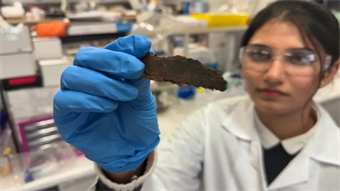
The OSU researchers applied molecular beam epitaxy (MBE) — an established technique of growing thin epitaxial layers of semiconductor crystals and nanostructures — to grow self-assembled aluminum gallium nitride nanowires directly on tantalum and titanium foils. Each wire measures about 200 nanometers tall and about 20-50 nanometers in diameter. In laboratory tests they light up nearly as brightly as those manufactured on more expensive, less flexible single-crystal silicon.
The researchers are working to make the nanowire LEDs even brighter, and will next try to grow the wires on foils made from more common metals, including steel and aluminum.