NASA Studies High-Altitude Radiation
Engineering360 News Desk | March 02, 2017Instruments aboard a giant helium-filled balloon have recorded some of the first stratospheric measurements of cosmic radiation coming from the Sun and interstellar space.
The measurements were made by NASA’s Radiation Dosimetry Experiment (RaD-X) launched in September 2015 near Fort Sumner, NM, at seven altitudes from 26,000 to over 120,000 feet above Earth.
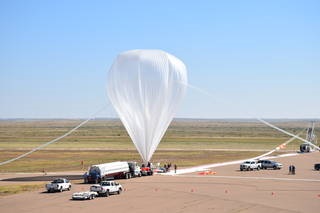 RaD-X prepares to launch from Fort Sumner, NM. Credits: NASA/Christopher MertensThe high-altitude balloon flight data provide measurements for assessing how well aviation radiation models characterize the source of secondary particles which dominate radiation exposure at commercial flight altitudes.
The mission is also expected to facilitate a pathway toward real-time, data assimilative predictions of aviation radiation exposure by identifying and characterizing low-cost, compact radiation detectors.
Measuring dose equivalent rate over a range of altitudes, they found a steady increase in the rate higher in the atmosphere, a finding seemingly contrary to the concentration of particles at the Pfotzer maximum of 60,000 ft -- the altitude at which the production of ionization in the atmosphere reaches a maximum. This can be explained by the complex interplay of primary and secondary particles at these altitudes, as the primary particles found higher up have a much more damaging effect on tissue than the secondary particles.
Because of their time spent in Earth’s upper atmosphere, aviation industry personnel are exposed to nearly double the radiation levels of ground-based individuals. Exposure to cosmic radiation is also a concern for crew aboard the International Space Station and future astronauts journeying to Mars, which has a radiation environment similar to Earth’s upper atmosphere.
Learning how to protect humans from radiation exposure is a key step in future space exploration.
The flight mission tested two new instruments – the RaySure detector and the Teledyne TID detector – to determine if they can be installed on commercial aircraft. These new instruments offer the advantage of being compact and easily produced. During RaD-X mission testing, both instruments were found to be promising candidates for future real-time, in situ monitoring.