Prosthetics Produced by 3-D Printing
Engineering360 News Desk | February 17, 2017A cyber manufacturing system engineered at University of Michigan shortens the fabrication time for custom orthotics and prosthetics.
The digital design and manufacturing process may also improve the devices' precision, fit, and function, and improve consistency from one provider to the next.
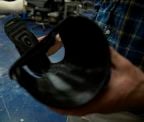 A finished 3-D-printed orthotic device.The process begins with a 3-D optical scan of the patient, after which the data is uploaded to a cloud-based design center. Specially developed software is used to design the assistive device and generate a set of electronic instructions, which are transmitted to the orthotist's facility. An onsite 3-D printer produces the device within a few hours (see video).
Conventional methods entail wrapping fiberglass tapes around the patient's limb, and waiting for the tapes to harden into a mold which is then filled with plaster to make a model of the limb. Heated plastic is formed around the model and the device is hand-finished by smoothing the edges and attaching mechanical components like straps.
The only onsite equipment required by the new process is an optical scanner, a computer, and a 3-D printer. This could give even small clinics in remote areas the ability to produce custom orthotics and prosthetics.
The lighter weight of the 3-D printed devices stems from a technique called sparse structure, which can make orthotics that are partially hollow using a wavy internal structure that saves weight without sacrificing strength.