Antimicrobial Could Fight Hospital Infections
Chuck Heschmeyer | January 19, 2017Spanish researchers have developed a light-activated antimicrobial in the fight against commonly acquired hospital infections.
The unique synthesized material is a molybdenum complex bonded to a polystyrene-type polymer and has applications as both a preventative and therapeutic bactericide.
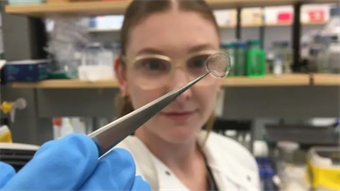
 UJI researchers Francisco Galindo and Alicia Beltran. Credit: UJI One of the most common culprits in hospital-acquired infections is the bacteria known as Staphylococcus aureus. In tests conducted by the Department of Inorganic and Organic Chemistry at Universitat Jaume I (UJI) in Castellón, Spain, this bacterium, when exposed to the molybdenum complex and light, was eliminated.
"The trials have been very promising, since virtually all of the bacteria exposed to the new material and light have been removed," says principal researcher Francisco Galindo.
The research is believed to be the first example of a molybdenum complex used for so-called antibacterial photodynamic therapy, which involves the use of substances that are activated by light.
Currently, researchers say, the field is dominated by porphyrin and phthalocyanine compounds, which tend to clump together and lose their efficiency. This does not happen with the molybdenum complex. Moreover, when bonded to a polystyrene-type polymer, it becomes photostable, meaning it doesn’t self-destruct upon contact with light, unlike other photosensitizers that tend to break down under prolonged exposure.
"This demonstration of the antimicrobial properties of molybdenum complexes leaves the field wide open to exploration and testing other compounds with different microstructures," Galindo says.
The most immediate application of the new material would be as bactericide for both preventive and therapeutic use. In preventative applications, the new material could be used to self-sterilize surgical instruments and other medical devices by applying light. As a therapeutic material, researchers said it could be used as a dermatological substance to treat skin pathologies, infections, and possibly even skin cancer.