
Beating hospital-acquired bacterial infections with bioactive glass
S. Himmelstein | March 08, 2019A new type of antimicrobial material is synthesized using a process similar to centuries-old stained glass techniques. The resulting bioactive glass offers scope to reduce the incidence of hospital acquired infections (HAIs).
Contaminated surfaces in health facilities are major agents of HAIs, and progress has been made in developing 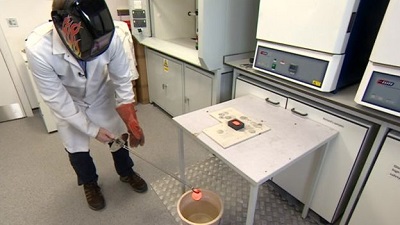 The glass is heated to over 1,000° C (1,832° F) before being rapidly cooled. Source: Aston Universityantimicrobial materials and protocols to improve disinfection efficacy. Germ-zapping robots delivering high-intensity ultraviolet light have been trialed for this application, and disposable examination gloves have been imbued with an antibacterial material to prevent the spread of pathogens to and from surfaces and people. Alcohol-releasing pushpads stuck onto push-activated hospital doors have also been designed to help decontaminate commonly-touched surfaces.
The new bioactive glass could provide a different disinfection service by direct application to tissues and instruments during surgical procedures. It could also be delivered in cartridges placed in catheters to prevent bacterial spread and subsequent urinary tract infections, which do not always readily respond to antibiotics. The cobalt-containing glass is fired in a furnace to over 1,000° C (1,832° F), cooled quickly to prevent crystallization and ground into a fine powder.
When glass samples with varying cobalt concentrations were added to petri dishes full of bacteria, the material with the highest amount of cobalt completely deactivated a population of Escherichia coli within six hours and Candida alibicans in 24 hours. Similar effects were observed for Staphyloccus aureus, as 99% were killed within 24 hours. The disinfection mechanism was observed to be cell wall disruption as bacteria contacted the antimicrobial metal ions.
Researchers from Aston University (U.K.), University College London, Coventry University (U.K.), University of Birmingham School of Dentistry (U.K.) and University of Alberta (Canada) participated in this study.


It would be nice if they could just disinfect everybody entering the hospital....or at least have a rapid screening process to detect dangerous bacteria carrying people entering who could be diverted to the process....
This would lead to separation between the entrance and treatment area...make the entire hospital an isolation ward....
Looks to be very similar process to that patented back in the 1970s (so now lapsed) with 'Controlled Release Glass' or 'CRG' developed at the Standard Telephone Laboratories in Harlow, UK. An offshoot of a study by Cyril Drake into solid state switches based on phosphate and borate glass materials. They turned out to be 'water sensitive' and on examining this property CD identified that glasses of this type were actually water soluble and could be 'engineered' to release materials at a controlled rate; materials like Ag (antiseptic properties), Cu (beef cattle growth stimulate alternative to hormones and also control of liver fluke in animal grazing pastureland. The WHO trialled the copper borate glasses in Nigeria to control water snails & break the Bilharzia parasite cycle), Se ('swayback' in sheep), Sn (antifouling paints for ships), Zn & P (anticorrosion paints using phosphate conversion steel when paintwork is scratched)… ...and these were just a few of the ideas we were 'incubating' back in those days. What goes around comes around!