NASA: Jet Propulsion by Hummingbird
Engineering360 News Desk | January 17, 2017A new Hummingbird engine concept from NASA’s Glenn Research Center can be used in aviation and marine propulsion and allows for distributed propulsion, enabling airframe and system modularity by allowing parts to be swapped or repaired easily.
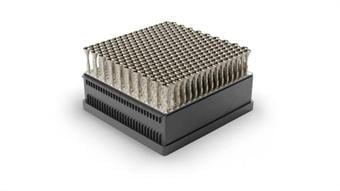
The design replaces a conventional jet engine with a linear array of flapping blades and diffusing vanes for compression, a combustor, and a linear array of expansion ducts. These expansion ducts convert thermal energy to magnetic energy using reverse magnetic hyperthermia, where the turbine ducts are lined with superparamagnetic composites that respond to thermal loads by generating alternating magnetic fields.
 A new engine concept from NASA's Glenn Research Center allows for truly distributed propulsion. Source: NASA's Glenn Research CenterThe magnetic energy can be used to drive the electromagnetic actuators required for flapping. Kinetic energy is delivered to the air using rapid oscillations rather than by rotation. This is converted to internal energy by the vanes.
Heavy shafts and disks are eliminated by the arrangement, which also enables subsonic to high supersonic flight with the same flowpath. In addition, the blades can be retracted to enable ramjet or scramjet mode.
The airframe can be modified to accommodate more or fewer passengers as needed. Because of the modular design, the thrust/lift is not lost completely if there is damage to the propulsion. In addition, parts of the propulsion system can be jettisoned in case of an emergency need to lower weight.