Jump in Green Tech Needed to Meet Emission Goals: Duke
Engineering360 News Desk | January 04, 2017The global spread of green technologies must quicken significantly to avoid future rebounds in greenhouse gas emissions, a Duke University study says.
Based on the researchers’ calculations, the climate warming goals set by the Paris Agreement will not be met unless the spread of clean technology can speed up by a full order of magnitude, or about 10 times faster than in the past.
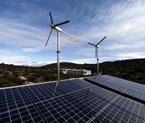 A hybrid wind and solar power system.Researchers determined that radically new strategies to implement technological advances on a global scale and at unprecedented rates are needed if current emissions goals are to be achieved.
The study uses delayed differential equations to calculate the pace at which global per-capita emissions of carbon dioxide have increased since the Second Industrial Revolution—a period of rapid industrialization at the end of the 19th century and start of the 20th. The researchers then compared this pace to the speed of new innovations in low-carbon-emitting technologies.
Using these historical trends coupled with projections of future global population growth, researchers were able to estimate the likely pace of future emissions increases and also determine the speed at which climate-friendly technological innovation and implementation must occur to hold warming below the Paris Agreement's 2° C target.
The researchers published their peer-reviewed findings in the open-access journal Earth's Future.
The analysis shows that per-capita CO2 emissions have increased about 100% every 60 years—typically in big jumps—since the Second Industrial Revolution. This "punctuated growth" has occurred largely because of time lags in the spread of emission-curbing technological advances, which are compounded by the effects of rapid population growth.
Gabriele Manoli, a former postdoctoral associate at Duke's Nicholas School of the Environment and who is now on the research staff at ETH Zurich's Institute of Environmental Engineering, conducted the new study with Gabriel G. Katul, the Theodore S. Coile Professor of Hydrology and Micrometeorology, and Marco Marani, professor of ecohydrology. Katul and Marani are faculty members at Duke's Nicholas School of the Environment with secondary appointments in the Department of Civil and Environmental Engineering at Duke's Pratt School of Engineering.