Marine Microalgae: A Sustainable Food and Fuel Source?
John Simpson | December 12, 2016Large-scale industrial cultivation of marine microalgae (ICMM) could help combat climate change, as well as energy and food insecurity, a Cornell University study suggests.
According to the study, ICMM could reduce fossil fuel use by supplying liquid hydrocarbon biofuels for the aviation and cargo-shipping industries. The biomass of microalgae remaining after the lipids have been removed for biofuels could then be made into nutritious animal feed or perhaps consumed by humans.
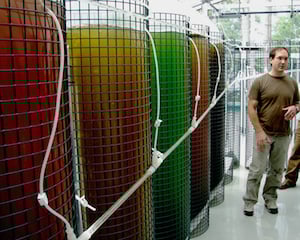 Microalgae are currently grown to supply nutrients for young shellfish. It could also be used to make biofuel and animal feed. Image credit: NOAA Aquaculture Program. “We got into this looking to produce fuels, and in the process we found an integrated solution to so many of society’s greatest challenges,” says lead researcher Charles Greene, professor of earth and atmospheric sciences.
To make the biofuel, scientists harvest freshly grown microalgae, remove most of the water and then extract the lipids for the fuel. The remaining defatted biomass is a protein-rich and highly nutritious byproduct—one that can be added to feeds for domesticated farm animals, such as chickens and pigs, or aquacultured animals, such as salmon and shrimp.
Growing enough algae to meet the current global liquid fuel demand would require an area of about 800,000 square miles, or slightly less than three times the size of Texas, the researchers estimate. At the same time, 2.4 billion tons of protein co-product would be generated, or roughly 10 times the amount of soy protein produced globally each year.
Marine microalgae do not compete with terrestrial agriculture for arable land nor do they require fresh water, the researchers note. Many arid, subtropical regions—such as Mexico, North Africa, the Middle East and Australia—would provide suitable locations for producing vast amounts of microalgae. And a commercial microalgae facility of about 2,500 acres could be built for about $400 million to $500 million.
“That may seem like a lot of money, but integrated solutions to the world’s greatest challenges will pay for themselves many times over during the remainder of this century," Greene says. "The costs of inaction are too steep to even contemplate."
Development of marine microalgae as a resource would "relieve the pressure to convert rainforests to palm plantations in Indonesia and soy plantations in Brazil,” Greene adds.