Messaging System Uses Household Chemicals
John Simpson | December 02, 2016Stanford University researchers have built a machine that sends messages using common chemicals. Among many potential applications, this system could relay secret messages or allow tiny devices to communicate inside the human body.
The chemical communication process is a straightforward concept. Like many systems, it relies on a binary code to relay messages. But instead of zeros and ones, it sends pulses of acid (vinegar) or base (glass cleaner).
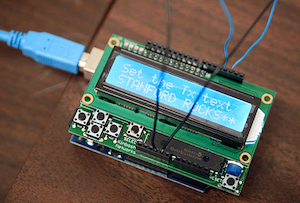 The machine sends text messages using vinegar and glass cleaner. Image credit: Stanford University.The researchers type their desired message in a small computer. The computer then sends a signal to a machine that pumps out the corresponding “bits” of chemicals, which travel through plastic tubes to a small container with a pH sensor. Changes in pH are then transmitted to a computer that deciphers the encoded message.
Nariman Farsad, postdoctoral research scholar in the Department of Electrical Engineering, chose these specific chemicals because they are easy to obtain and they cancel each other out at the receiving end of the system. In an earlier version of the chemical texting process, in which vodka was used to send messages, the signal would build up to the point that the receiving end was too saturated with vodka to receive more messages.
One of the remaining challenges is figuring out how to separate the signal from the noise at the end of the transmission. Upgrading from vodka to the acid-base combination was an immense improvement, but the chemicals still leave residue behind as they move through the channel.
The researchers are also looking into how chemical communication could advance nanotechnology. Cost-effective nanotechnology devices already exist that may someday operate inside the human body. But they are so small that, in order to communicate, they must either be wired together or depend on high-frequency signals, which could potentially cause organ damage.
These signals also tend to travel only short distances, and a method for powering them has yet to be developed. As an alternative, chemical-based data exchange could be self-powered, traveling throughout the body harmlessly and undetected by outside devices.
“This is one of the most important potential applications for this type of project,” Farsad says. “It could enable the emergence of these tiny devices that are working together, talking together and doing useful things.”