UK Rolls Out Plastic Money
Chuck Heschmeyer | November 09, 2016In the UK, plastic money is now the real deal. The Bank of England has rolled out a polymer £5 note, with the £10 note to follow in the summer of 2017, and a £20 note by 2020.
The polymer banknotes are manufactured from a transparent plastic film coated with an ink layer that enables it to carry the printed design features of banknotes. The material allows the inclusion of “windows,” or clear portions in the design that enhance protection against counterfeits.
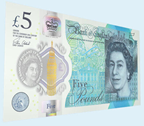 New polymer £5 note. Image source: Bank of EnglandThe Bank’s decision to switch to printing on polymer rather than paper was made after a three-year study of various materials concluded that polymer offered several compelling advantages.
Bank of England says the banknotes are more durable and more secure than the paper version and will increase the quality of banknotes in circulation. Because the new notes are resistant to dirt and moisture, more hygienic and machine washable, they’ll stay cleaner and have a longer lifecycle, more than 2.5 times longer, than paper banknotes. The fact that they’re recyclable also makes the polymer notes more environmentally compatible than previous versions.
The new notes have been designed to be difficult and time consuming to copy by both traditional and computer-based printing methods. The notes are manufactured by the bank’s printer, De La Rue Plc, using biaxially oriented polypropylene, a type of plastic that has been strengthened by stretching it in two directions.
A number of security features have been baked into the design to make it difficult for would-be counterfeiters to create prints. These include raised print, the feel of paper, watermarks, an ultra-violet feature, a see-through window, and the foil Elizabeth Tower which is gold on the front of the note and silver on the back.
The paper £5 notes already are being withdrawn from circulation as they are deposited by shops and businesses and will cease to be legal tender after May 5, 2017. After that, holders will need to exchange their paper £5 notes directly at the Bank of England.