Carbon-negative energy systems based on biomass
N. Mughees | September 05, 2025Carbon-negative energy systems using biomass is a transformative approach to tackling climate change by coupling renewable energy generation with carbon dioxide (CO2) removal. These systems generally involve processes such as biomass gasification, pyrolysis, fermentation or hydrothermal carbonization, often integrated with carbon capture and storage or biochar production. The key advantage is their ability to remove atmospheric CO₂ while producing energy — unlike carbon-neutral systems that simply offset emissions. Current innovations include integrating solar energy, artificial intelligence (AI)-driven supply chain optimization, bioenergy with carbon capture and sequestration (BECCS) and novel thermochemical conversions, making these systems increasingly efficient and scalable.
How does biomass remove CO₂ from the atmosphere?
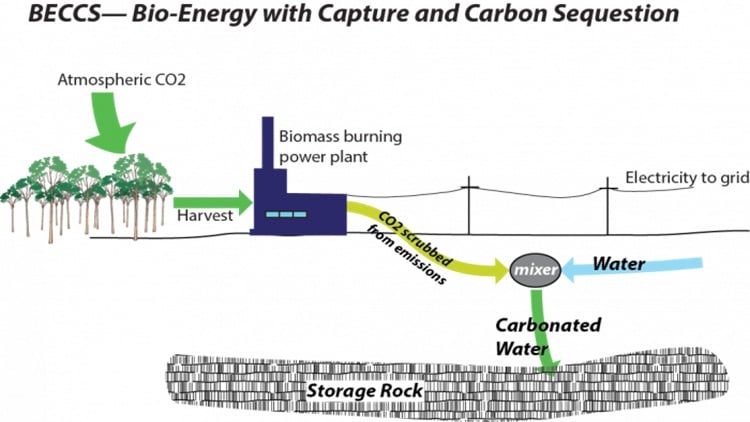 A schematic representation of a BECCS system, which utilizes fast-growing plants to remove CO2 from the atmosphere, turning it into biomass that is harvested and burned in a power plant to produce electricity. The combustion emissions are scrubbed to remove the CO2, which is then sequestered in a suitable geologic formation below the surface.Source David Bice/Pennsylvania State University
Step 1: Absorbing CO₂ via biomass growth
Biomass growth is the first step in the carbon removal process. Biomass comprises anything organic that comes from living or recently lived things, such as trees, grasses, algae, agricultural wastes or even food and animal waste. What makes biomass special in this context is that it absorbs CO2 directly from the atmosphere through photosynthesis — the natural process plants use to grow.
During photosynthesis, plants use sunlight to convert CO₂ from the air and water from the soil into carbohydrates (like glucose), which they use to build stems, leaves, roots and other biomass. In chemical terms, the reaction looks like this:
6 CO₂ + 6 H₂O + sunlight → C₆H₁₂O₆ + 6 O₂
This means that for every molecule of glucose a plant creates, it pulls six molecules of CO₂ from the atmosphere. As the plant grows, it stores this carbon in solid form as cellulose, lignin and other organic compounds. Over time, entire forests, fields or algal blooms become massive temporary carbon sinks, locking carbon into plant matter.
What makes this different from fossil fuels is the timescale. Fossil fuels are ancient carbon — they release carbon that was buried millions of years ago. Biomass, on the other hand, removes and stores CO₂ from today’s atmosphere, making it part of the current carbon cycle.
In carbon-negative systems, the key innovation is interrupting the natural decay or combustion cycle that would normally return this CO₂ to the air (e.g., through rotting or burning) and instead diverting it toward long-term storage — either chemically, physically or geologically.
Step 2: Controlled conversion + carbon capture
Once biomass captures atmospheric CO₂ through photosynthesis, the next challenge is to prevent that carbon from returning to the atmosphere. One of the most prominent methods is BECCS. In BECCS, biomass is burned or converted into syngas to generate electricity or fuels, and the resulting CO₂ emissions are captured before they escape into the air. This captured CO₂ is then compressed and injected deep underground into geological formations like saline aquifers, where it can remain safely stored for thousands of years, effectively removing carbon from the atmosphere.
Pyrolysis, a process that includes heating biomass without oxygen, is another approach that is gaining popularity. This procedure disintegrates the material into three components: a gas (syngas), a liquid (bio-oil) and a solid (biochar). While syngas and bio-oil can be used for energy, the biochar — a stable form of carbon — can be buried or added to soils. Applying biochar to farmland has multiple benefits, including improved soil fertility and water retention in addition to storing carbon for hundreds to thousands of years.
Gasification is a related process where biomass is subjected to high temperatures with limited oxygen, producing a gas mixture of hydrogen, carbon monoxide and CO2. With the integration of carbon capture technologies, the CO₂ can be separated and stored, achieving net-negative emissions if the biomass source is sustainably managed.
Supercritical water gasification is another advanced technique where wet biomass is reacted with water at extremely high temperatures and pressures. This breaks down organic materials into hydrogen and carbon dioxide. The hydrogen can be used as a clean fuel, while the CO₂ is captured and stored, making the overall system carbon negative.
Hydrothermal carbonization is a process tailored for wet biomass like food waste or sewage sludge. Under moderately high pressure and low temperature, the biomass is converted into a coal-like material called hydrochar and a carbon-rich gas. The hydrochar can be buried or used as a soil amendment, while the gases may be captured and reused.
Finally, fermentation-based systems (such as those producing ethanol) can also be made carbon-negative. During fermentation, microbes convert biomass sugars into alcohol, releasing CO₂ as a byproduct. If this CO₂ is captured instead of released, and especially if the ethanol is used in a clean-burning context, the system can achieve a net reduction in atmospheric carbon.
Real-world example of a carbon capture and storage system
The Archer Daniels Midland (ADM) ethanol facility in Decatur, Illinois, stands out as a pioneering example of large-scale carbon-negative bioenergy. Unlike fossil-fuel plants, ADM’s approach is rooted in bioethanol production, where corn is fermented to produce ethanol for fuel. During this fermentation process, pure CO₂ is naturally released — a byproduct that most ethanol plants vent into the atmosphere. ADM, however, captures it.
Since 2017, ADM has operated a full-scale BECCS system through the Illinois Industrial Carbon Capture and Storage (ICCS) project, backed by the U.S. Department of Energy. It’s among the first in the world to demonstrate commercial-scale carbon removal using biomass.
Conclusion
Carbon-negative energy systems that are based on biomass are transitioning from proof-of-concept to scalable solutions. Their success is contingent on the successful integration of carbon capture technology, favorable legislation and the optimization of biomass supply chains through the application of intelligent technologies.