Saltier Intertidal Beaches Could Endanger Coastal Sea Life
John Simpson | September 12, 2016Samples of sand from a beach on the Delaware Bay are yielding insights into the powerful impact of temperature rise and evaporation along the shore—and challenging long-held assumptions about what causes beach salinity to fluctuate in coastal zones.
The study, by the New Jersey Institute of Technology's (NJIT) Center for Natural Resources Development (CNRDP), analyzed nearly 400 sediment samples collected during the sequential phases of a complete tidal cycle, from day to night, on seven discontinuous days at Slaughter Beach, in Delaware. It found that sediments from some sections of the beach have salt concentrations four times as high as the ocean water that washes over them.
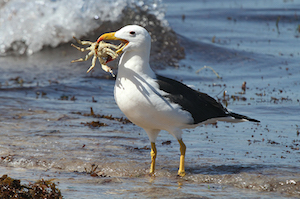 The intertidal zone, washed by seawater at high tide and uncovered at low tide, is home to a large variety of coastal sea life. Image credit: Pixabay.The nearshore seawater the team measured had salt concentrations of 25 grams per liter (g/L), leading the researchers to expect that the subsurface water in areas of the beach it infiltrated would have similar or even lower levels, as seawater mixes with inland groundwater in this zone. However, they discovered that the average salinity in the upper intertidal zone—the high-tide line—was 60 g/L, with some values reaching as high as 100.
“These elevated levels can only be caused by evaporation, as there is no other mechanism for increasing the salt in pore water—the water trapped between the grains of sediment,” says Xiaolong Geng, a postdoctoral fellow at NJIT and the principal author of the study. He notes that the rates of evaporation and salinity are mainly determined by temperature and relative humidity, while tide and wave flows dilute a beach’s salt content.
“Previous studies have identified seawater as the primary source of salinity in coastal aquifer systems, thereby concluding that seawater infiltration always increases pore-water salinity by seawater-groundwater mixing dynamics,” says Michel Boufadel, director of the CNRDP.
The intertidal, or littoral, zone is a dynamic habitat, washed by seawater at high tide and uncovered at low tide, that is home to crabs, mussels, sea anemones, the birds and sea mammals that feed on them and plants such as kelp. Many of these animals burrow in the beach to find food and to seek protection from predators and the action of waves and are in near-constant contact with pore water.
The researchers have developed models showing that increases in temperature associated with global warming will not only make inland locations more salty, but also create drastically different patterns of pore-water salinity that will have implications for animals and plants in the intertidal zone.
“Evaporation is an important driver of underground water flow and salinity gradients, and animals such as mussels and crabs are affected by changes in salinity. If the concentrations are too high or too low, they will move away,” says Geng.