Mass-actuated Control Could Change Aircraft Design
John Simpson | August 18, 2016A recent graduate of the aerospace engineering program at the University of Texas at Arlington has flight tested an unmanned aerial vehicle (UAV) that uses moving weights in its wings instead of traditional control surfaces or ailerons to turn. The test could prove important in designing future aircraft, as it would potentially allow engineers to eliminate ailerons and elevators, which increase drag.
Ailerons and elevators are the movable surfaces, usually near the trailing edge of a wing and tail, respectively, that control the roll and pitch of an airframe and affect maneuvers, such as turns. The UAV designed, built and tested by Sampath Vengate uses mass actuation—weights that move back and forth within the wings to change the center of gravity from side to side—to turn while airborne.
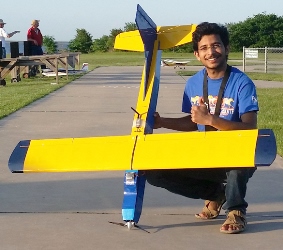 Sampath Vengate with a UAV that uses weights in the wings to maneuver. Image credit: University of Texas at ArlingtonVengate became interested in the concept as an undergraduate when he entered a competition that called for a UAV to carry a weighted payload that was off-center on the aircraft and drop it on a target. The challenge was to get the aircraft back to ground safely by developing a way to handle the imbalance after the drop. Although he failed to complete that objective, the idea struck him afterward that masses inside an aircraft could be used not only to return the aircraft to level, but also to help maneuver the aircraft.
Vengate began his research by using a simulation environment to test the feasibility and potential benefits of his theory. Once the simulation showed that mass actuation could work, he began designing an airplane using computer-aided design tools.
He built a UAV from scratch using a laser cutter to create custom braces to form the wings and hold the actuators in place. His aircraft incorporated ailerons, elevators and a rudder in addition to the actuators in case the test failed. But he was able to successfully use the actuators to turn the aircraft.
In addition to reducing drag, eliminating ailerons and elevators has potential application for specialized aircraft. Removing these control surfaces could reduce a stealth plane's radar signature and, in the case of hypersonic aircraft, potentially help avoid the build-up of unsafe temperatures that could damage the aircraft.