Drop-in fuels flower from artificial leaf
S. Himmelstein | June 28, 2023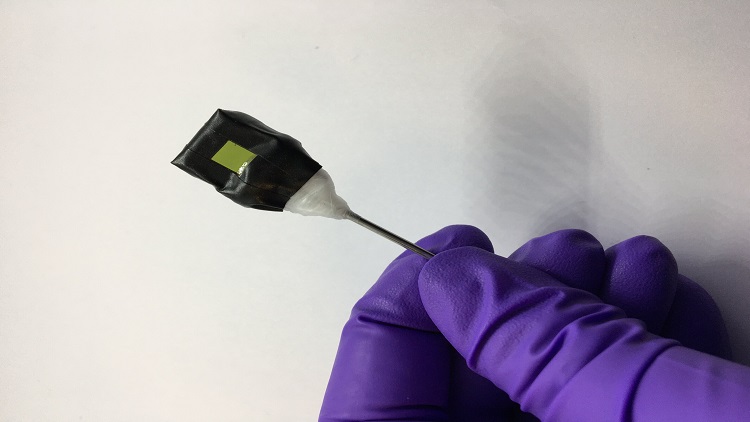 A standalone artificial leaf attached to a metal rod support. The photoanode side is visible as the green square. Source: Motiar Rahaman/University of Cambridge
University of Cambridge (U.K.) researchers have nurtured artificial leaf technology for the photocatalytic conversion of carbon dioxide and water into zero carbon drop-in automotive fuels.
The proof-of-concept system combines an oxide-derived cadmium-palladium electrocatalyst with perovskite-bismuth vanadate tandem light absorbers. The arrangement couples carbon dioxide reduction with water oxidation to yield ethanol and n-propanol, which are of value as high energy density fuels that can be easily transported and stored.
The solar-driven system described in Nature Energy directly produces clean ethanol and propanol without the need for the intermediary step of producing syngas typically required in artificial photosynthesis technology.
Efforts will now focus on optimizing the light absorbers to increase solar radiation capture sunlight and expanding the capacity of the catalyst to convert more sunlight into fuel. The next goal is to render the device scalable so that it can produce large volumes of fuel.