Mussel Inspires Creation of Biologically Active Titanium Surface
John Simpson | July 30, 2016Titanium is used medically in applications such as artificial joints and dental implants. While it is strong and is not harmful to tissues, the metal lacks some of the beneficial biological properties of natural tissues such as bones and teeth.
Now, based on insights from mussels—which are able to attach themselves tightly to even metallic surfaces due to special proteins found in their byssal threads—scientists from the Japanese natural sciences research institute RIKEN have successfully attached a biologically active molecule to a titanium surface, paving the way for implants that can be more biologically useful.
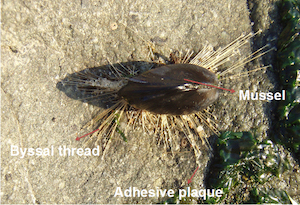 Mussels are able to attach themselves tightly to even metallic surfaces due to special proteins found in their byssal threads. Image credit: RIKEN. The work evolved from earlier studies that determined that mussels' ability to attach to smooth surfaces so effectively is the result of a protein, L-DOPA, that can bind very strongly to smooth surfaces such as rocks, ceramics or metals. Interestingly, the same protein functions in humans as a precursor to dopamine and is used as a treatment for Parkinson’s disease.
"We thought it would be interesting to try to use various techniques to attach a biologically active protein—in our case we chose insulin-like growth factor-1 (IGF-1), a promoter of cell proliferation—to a titanium surface like those used in implants," says Chen Zhang of the RIKEN Nano Medical Engineering Laboratory.
Using a combination of recombinant DNA technology and treatment with tyrosinase, they were able to create a hybrid protein that contained active parts of both the growth factor and L-DOPA. Tests showed that the proteins were able to fold normally, and further experiments in cell cultures demonstrated that the IGF-1 was functioning normally.
Thanks to the incorporation of the L-DOPA, the team was able to confirm that the proteins bound strongly to the titanium surface and remained attached even when the metal was washed with phosphate-buffered saline, a water-based solution.
“We are very excited by this finding because the modification process is a universal one that could be used with other proteins," says Yoshihiro Ito, leader of the Emergent Bioengineering Research Team at RIKEN. "It could allow us to prepare new cell-growth-enhancing materials, with potential applications in cell culture systems and regenerative medicine."