Shellfish Chemistry Used to Design New Adhesive
Chuck Heschmeyer | January 27, 2017Researchers at Purdue University in Indiana have designed a type of adhesive that combines the bonding chemistry of shellfish with a bio-based polymer that’s been shown to perform as well as commercially available products. The new adhesive degrades easily and may represent a potential non-toxic alternative to conventional adhesives.
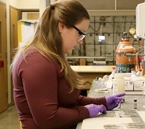 Graduate student Heather Siebert tests the adhesive. Most commercial adhesives are made of off-gassing reactive chemicals, says Jonathan Wilker, professor of chemistry and materials engineering at Purdue. “Most of these glues are also permanent, preventing disassembly and recycling of electronics, furniture and automobiles. In order to develop the next generation of advanced adhesives we’ve turned to biology for inspiration.”
Specifically, researchers looked at mussels in designing the new adhesive, as explained in this video.
Mussels extend hair-like fibers that attach to surfaces using plaques of adhesive. Proteins in the glue contain the amino acid DOPA, which harbors the chemistry needed to facilitate the cross-linking of protein molecules. This provides both strength and adhesion, researchers say.
They then combined the bonding chemistry of mussel proteins with a corn-derived polymer, polylactic acid, or PLA. The adhesive was created by harnessing the chemistry of compounds called catechols contained in DOPA.
Researchers tested the adhesive by measuring the force needed to pull apart metal and plastic plates bonded together. They found that it compared favorably with various commercial products and, unlike synthetic glues, the adhesive can be easily degraded in water.
“Results show that a promising new adhesive system can be derived from a renewable resource, display high-strength bonding, and easily degrade in a controlled fashion,” Wilker says. “Particularly unique was the ability to debond this adhesive under mild conditions.”
Researchers hope the findings can lead to adhesives and other materials that are sourced from natural feedstocks and easily biodegrade.