Film that Oscillates in Visible Light Is Created
Riia O’Donnell | July 12, 2016A material developed at Eindhoven University of Technology (TU/e) and the Humboldt University in Berlin is capable of moving on its own when exposed to visible, unprocessed sunlight. The material could be used for self-cleaning surfaces, such as solar cells, that perform more effectively when clean.
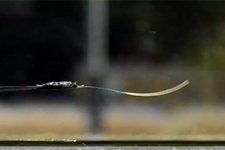 Thin film moves independently under normal light conditions. Image source: Eindhoven University of Technology The polymer layer contains azo-dyes, which are light-sensitive molecules. When they are exposed to sunlight they oscillate spontaneously and in an irregular fashion. Researchers say they are not sure exactly why the material moves on its own, but they speculate that a combination of processes are occurring: the light-sensitive molecules stretch and bend when exposed to light, and, because they are bound within the polymer network of crystal, the material is cramped and moves on its own.
The film also displays its chaotic self-oscillation when exposed a combination of common green and blue LEDs.
The F-azo material is made when a rubbed planar polyimide and a homeotropic polyimide-coated plate are glued together with 18 μm spacers, and filled by a LC mixture of the monoacrylates. It demostrates fully reversible and continuous actuation with bending angles that vary between −2 and 12°.
Although the material mimics a typical biological system’s response to light, it uses sunlight as a continuous energy source, rather than a stimulus. This behavior could mean the material has applications that go beyond self-cleaning coatings. For example, it could be used to develop self-propelling and self-morphing soft actuators that could operate in dry environments.