Robotics Are Activated with Vacuum to Enhance Safety
Riia O’Donnell | June 06, 2016A team from Harvard University’s Wyss Institute for Biologically Inspired Engineering has developed actuators that could be the basis for soft-bodied robotics that may be safer than other robotics when used in proximity to humans.
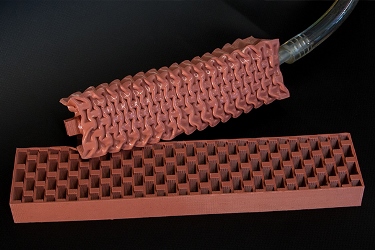 VAMPS in its open and closed positions. Image source: Wyss Institute at Harvard University The actuator mimics the movement of skeletal muscles by using vacuum power to automate soft, rubber beams in its structure. As in a human, the actuators are soft and absorb shock. They can work alongside humans and pose little or no danger to them or their environment in the event of an error.
Called VAMPS (vacuum-actuated muscle-inspired pneumatic structures), the devices essentially model the human bicep. The team says that although other soft actuators are in use, they believe that theirs most similarly mimic muscle in terms of response time and efficiency.
The team used a vacuum to decrease volume and cause it to buckle. Where other soft actuators use pressure to expand volume, the VAMPS uses the buckling to its advantage. The researchers say the VAMPS’ ability to more closely mimic muscle action because of how it contracts will make the device easier to use in small or confined spaces.
VAMPS are soft rubber or elastomeric beams that have a honeycomb structure filled with hollow chambers. The chambers collapse with the application of vacuum, contracting the entire actuator and generating movement. The internal honeycomb structure can be tailored for linear, twisting, bending or a combination of motions. Additionally, they are designed to prevent failure. If VAMPS fails, it loses pressure and become motionless.