This robot lifts weights, crawls through pipes
Marie Donlon | July 11, 2024The engineering team reportedly used the actuator device to construct an artificial bicep capable of lifting a 500 gram weight, 5,000 consecutive times and a worm-inspired soft robot capable of navigating hairpin curves in a narrow pipe.
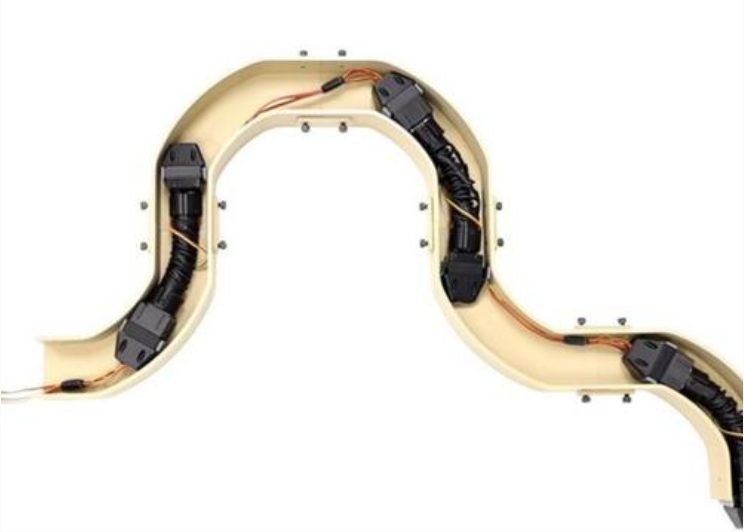 Source: Ryan Truby/Taekyoung Kim/Northwestern University
To create the devices, the team 3D printed the cylindrical structures of the soft actuator, dubbed “handed shearing auxetics” (HSAs), using rubber. According to the researchers, the HSAs are challenging to fabricate but possess a structure that enables for unique movements and properties, including extending and expanding when twisted.
As such, the HSAs were 3D printed using thermoplastic polyurethane, a common rubber found in cellphone cases, which reportedly made the HSAs softer and more flexible. Yet, the team noted that they encountered a challenge with twisting them to achieve extension and expansion.
While previously designed HSA actuators used servo motors to twist the materials, the assembly of the two or four HSAs required, each with its own motor, made fabrication difficult and also reduced flexibility. Consequently, the team sought to construct a single HSA driven by one servo motor. However, they needed to first develop an approach for a single motor to twist a single HSA.
To accomplish that, the team added to the structure an extensible, soft rubber bellows that behaved as a revolving, pliable shaft. With this addition, the actuator stretched as the motor generated torque, which is the force for rotating an object. The researchers explained that the actuator is encouraged to stretch or contract by rotating the motor in one direction or the other.
The team then used the bellows to create a soft robot capable of crawling with just one autonomous actuator, pushing and pulling the robot throughout a pipe-like environment.
The team suggests that the new actuator could lead to the creation of inexpensive, soft and flexible robots that are safer for real-world applications.
The technology is detailed in the article “A Flexible, Architected Soft Robotic Actuator for Motorized Extensional Motion,” which appears in the journal Advanced Intelligent Systems.
For more on the actuator, watch the accompanying video that appears courtesy of Northwestern University.