Study Shows Current Offshore Platforms Can Survive Sea Ice
Engineering360 News Desk | May 03, 2016A study undertaken by the U.S. Department of Interior's Bureau of Safety and Environmental Enforcement (BSEE) and the University of Alaska has concluded that offshore platforms built to current international standards can successfully survive sea ice demands under extreme Arctic conditions.
The objectives of the study were to produce information that would supplement current standards—such as ISO 19906 Standard: Petroleum and Natural Gas Industries - Arctic Offshore Structures—and to provide additional sea ice information regarding the Beaufort and Chukchi seas, located off the north and northwestern coasts of Alaska, respectively. Significant research and exploration have been conducted by the energy industry in these areas, as it is believed they could contain vast hydrocarbon reservoirs.
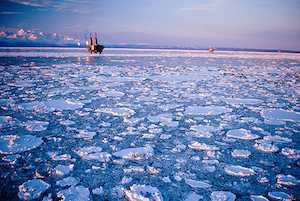 The Beaufort and Chukchi seas likely contain vast hydrocarbon reservoirs. Image credit: BSEE.Over a two-year period, researchers gathered data from 16 seasons of ice measurements from the regions—sufficient to provide comparisons of various sea ice parameters, such as first and last ice occurrence, level of ice, rubble fields, ridges and ice movement. The study identified critical keel depth and provided an assessment of the suitability of the current ISO 19906 recommendations for estimating global ice forces on offshore structures.
Following collection and analysis of the data, the researchers concluded that it appears the current standard of practice cited in ISO 19906 is conservative for structural design parameters and thus appropriate for guiding the construction of offshore platforms that can survive the demands from sea ice.
BSEE’s Technology Assessment Program, under which the study was carried out, is designed to ensure that offshore industry operations incorporate the best available and safest technologies as required by the Outer Continental Shelf Lands Act and Energy Policy Act. The agency says there are currently seven additional studies ongoing that are assessing offshore engineering technology and the conditions that operators face in harsh Arctic conditions.