Preventing Silt Build-Up Behind Dams
Engineering360 News Desk | May 02, 2016Researchers from the École Polytechnique Fédérale de Lausanne (EPFL), in Switzerland, have developed a method of keeping sediment behind dams in suspension, allowing it to be flushed rather than building up on the lakebed at the expense of reservoir capacity.
All dams have the same problem: sediment accumulates in the reservoir. This situation is commonly addressed by building in "dead storage" capacity at the bottom of the reservoir where alluvium is allowed to settle. But if these silt deposits are never cleared out, the reservoir will become blocked in as little as a few decades and turn into a sandy beach.
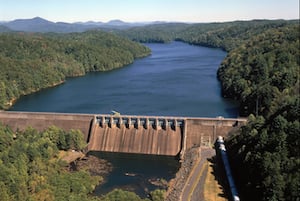 All dams have the same problem: sediment accumulates in the reservoir. Image credit: Pixabay.One approach to clearing out sediment is through the rapid release of water through the dam every 10 to 20 years. This is a radical maneuver, however, that effectively clears out the reservoir but frequently devastates everything downstream, including fauna and flora. A second method is to clean the alluvium from the dam—an extremely expensive undertaking, since the sediment can build up over 100 meters or more along the dam.
To address the problem in a different way, the EPFL team developed a system using submerged water jets to create turbulence that keeps tiny sediment particles in suspension so that they can be carried away through the dam’s water turbines. The process, which is designed to prevent sediment from settling to the bottom—and may even remove silt already on the bottom—is set to prolong the useful life of reservoirs, according to the researchers.
The approach based on submerged water jets was tested in various configurations in EPFL's Laboratory of Hydraulic Constructions. In a 12-cubic-meter tank, four water jets were installed and positioned to create rotational flow, and 3kg of walnut shell powder was poured in. “Ground walnut shell is the same size as the sediment but slightly lighter, so we can use it to effectively extrapolate what would happen in the dam reservoir,” says Giovanni De Cesare, EPFL senior research and teaching associate.
The researchers found that four jets in a horizontal plane worked best to keep particles in suspension. They further discovered that, depending on the height of the jets, the direction of rotation changes and increases the zone in which the turbulence has an effect. The turbulence sends the particles off in all directions rather than confining them to just one zone.
The engineers then transposed their results to a real-world situation: the Mauvoisin Dam in Valais Canton, Switzerland. Preliminary calculations of the effectiveness of the water-jet technique show that 20% of sediments could be prevented from settling at the bottom of the reservoir each year. The water jets at Mauvoisin could also operate non-stop, as they would be powered by a natural spring that feeds into the reservoir from a height of over 100 meters, providing sufficient pressure.