
This R&D flow sensor measures hydrogen in pipe, regardless of size
Marie Donlon | October 02, 2026A team of researchers from SINTEF in Norway has developed a sensor capable of measuring the energy density of hydrogen.
Because it is nearly impossible to precisely measure the mass flow of hydrogen for correct accounting in the hydrogen economy, the team sought to develop technology that could measure how much hydrogen flows past a given point in the pipe. The team developed the technology at the request of Cignus Instruments.
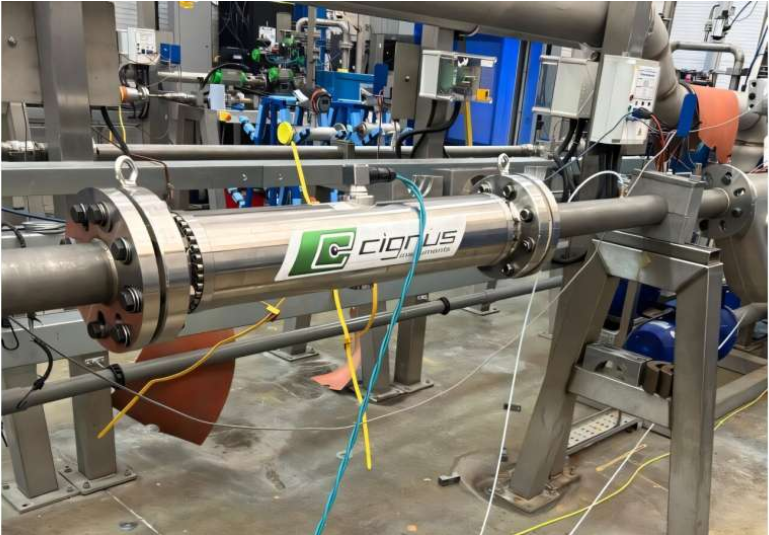 Source: SINTEF
Natural gas and hydrogen are valuable energy carriers, but hydrogen’s extremely low density makes it difficult to measure accurately. This measurement challenge has become a barrier to the wider adoption of hydrogen. Precise measurements are essential for determining how much hydrogen is produced, sold and transported.
The developers of the new sensor explain that hydrogen behaves differently from other gases when flowing through pipes. Because hydrogen is extremely light, sensitive and compressible, even minor changes in pressure and temperature can significantly affect conventional measuring instruments. And because hydrogen has the smallest molecules of any gas, contamination with larger molecules can have a pronounced impact on measurements.
Existing mass-flow meters typically use tubes arranged in a small, thin loop that vibrates. As gas or liquid moves through the loop, it causes minute changes in the tube, which subsequently alter the vibration pattern.
The team suggested that by measuring these changes, the mass flow in the piping can be determined. These devices, dubbed Coriolis flow meters, require precise tube dimensions, making them difficult to use for high-pressure hydrogen, which requires thick, rigid pipes and high flow capacity.
However, per the research team, the new meter has no pressure or size limitations while being sensitive enough for measuring hydrogen and other light gases, like natural gas.
The new hydrogen meter uses a four-channel design that can fit pipes of various sizes and thicknesses while measuring mass flow rather than volume. Simulations show it can accurately measure hydrogen even near pipe bends. The technology is still being developed and must be verified and certified, with applications including electrolyzer production monitoring and hydrogen pipeline transport.
Is it a kind of thermal mass flow meter