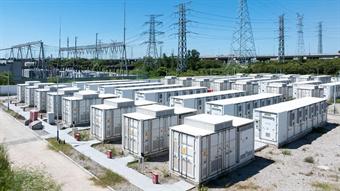
Can data centers stabilize the grid?
Michael A Mullane for IEC e-tech | September 14, 2026 Data centers are not going away and regulators need to figure out how to turn these massive resources hogs into a resource for the people argues IEC. Source: IEC
Editor's note: This article originally ran on e-tech and appears here courtesy of the IEC.
There is a story in Greek mythology about a king’s insatiable appetite that could serve as a parable for the modern-day power challenges of data centers. When King Erysichthon of Thessaly cut down all the trees in a sacred grove, the goddess Demeter cursed him with unrelenting hunger. Nowadays, data centers are doing all the eating, consuming vast amounts of electricity while growing hungrier all the time. Driving the demand is artificial intelligence (AI), which the International Energy Agency (IEA) expects to cause data center power consumption to double by 2030.
“We estimate that their electricity consumption increased by 17% last year, growing more than five times faster than total electricity consumption,” said IEA expert Thomas Spencer, speaking at the AI For Good summit in July. Data centers will account for around one tenth of global electricity demand growth to 2030, he added. That is less than the share from industrial motors, air conditioning in homes and offices, or electric vehicles (EVs), but what sets the data center challenge apart is geography with electricity use concentrated in a handful of countries. The United States accounts for 45% of global data center electricity use, China 25%, and Europe 15%. A single AI-focused data center already draws as much power as 100,000 households. The largest ones now under construction will draw 20 times that amount.
Constraints on the electricity grid and rising prices
This is placing a huge strain on the electricity grid in several different places around the world from Dublin to Tokyo, while also fomenting local unrest and opposition. Aside from complaints about noise and emissions, demand from data centers is driving up wholesale energy prices. A report commissioned by Friends of the Earth outlines the cost of data centers in Ireland. It claims that the rapid expansion of data centers has already added the equivalent of EUR 360 to household electricity bills in the country and they now face up to EUR 644 extra. This is because data centers tend to be built in clusters, close to the cities and neighborhoods where power and connectivity are easiest to reach. Speaking at the AI for Good summit, Molly Webb, CEO of the NGO Energy Unlocked, thinks that opaque government decision-making exacerbates the situation further. “There has been a real lack of transparency and a lot of secrecy around some of these data centers,” she said.
Dr Howard Porter is an energy efficiency and clean tech expert leading work on data centers for the IEC Market Strategy Board (MSB). He points to his own experience of living in the United Kingdom, where grid constraints have encouraged a number of data centers to plan their own gas-fired power stations. That, Porter says, is "reversing the UK's electrification agenda" and running counter to the government's climate plans.
Turning data centers into a resource
Porter argues that data centers can be more than just power-hungry customers. While acknowledging that the energy demands of data centers are a significant challenge for the grid, he believes that if managed efficiently, they could actually help to stabilize it. The real challenge, he explained, is not that data centers consume too much power, but rather that they use it in the wrong places and faster than the grid can plan for. “Data centers can no longer be treated as an afterthought,” he said. “For regulators and industry, the real question isn’t whether they keep growing, but whether they expand as a burden on the grid or as part of the solution.”
The answer, he said, is to harness forward-looking regulations to turn data centers into a resource. For instance, data centers are packed with enormous batteries and backup generators. But this power infrastructure usually lies idle, waiting for outages that rarely come. Porter said that in many places idle capacity is a massively wasted asset that could be used in the grid.
He noted that Google and Microsoft already use data center batteries and demand-shifting software to help stabilize networks in Ireland and elsewhere, delaying costly network upgrades. New hardware, including grid-forming inverters, high-voltage direct current (DC) power systems and solid-state transformers, would allow facilities to do far more of this, feeding power back or throttling demand within milliseconds when grids need help.
Regulators, industry and standards organizations must work together
Japan offers the clearest example of what coordinated planning looks like. Facing data center sprawl around Tokyo and Osaka, Japan's government launched what it calls "Watt-Bit integration." The idea is planning power generation and data infrastructure together, rather than bolting one onto the other after the fact. A joint public-private council has designated dedicated "Green transformation zones,” which pair new data center clusters directly with gigawatt (GW) scale renewable power and high-capacity communications links. The goal is to stop building data centers first and asking the grid to catch up later.
Policy makers and regulators rely on international standards to ensure technical uniformity and save time and money, as well as allowing laws to remain flexible and aligned with best practices. International standards play a critical role in enabling efficient, resilient and sustainable data centers. They support energy efficiency, grid integration, cyber security and operational performance, among others. IEC Standards underpin energy efficient digital infrastructure, smart grids and interoperability. (To find out more about IEC and ISO Standards for data centers, read Boosting the energy efficiency of data centers | IEC e-tech).
A new IEC report calls for action
An IEC report — called Clean Green Data Centers — and which will be published later this year, is expected to call for urgent action from international standards development organizations, data center operators and regulators. For the IEC, that means defining what "AI-ready power quality" even means, with hard numbers for voltage tolerance and disturbance limits. While high voltage DC standards exist, such as for instance, IEC Technical Specification 61936 or IEC 62896, many more will be needed for the high-voltage DC systems required by new data centers.
The experts behind the report want the IEC to ensure that grid operators, chipmakers and cloud giants speak the same technical language to prevent fragmentation setting in.
IEC could play a referee role
Porter, who coordinated work on the report, says the role of the IEC is not to be a rule maker but a referee people actually trust. "There are opportunities for the IEC to be an international commentator on good practice around the world, backed up by strong standardization," he said. The goal, as he sees it, is for regulators and operators alike to recognize that they have a problem and that the IEC and its sister organization, ISO, have the answers.
In Greek mythology, there are several versions of what happened to Erysichthon. In some, he ends up eating himself, while in others he squanders all his wealth on food and ends his days as a beggar. Will data centers eat us out of house and home, overwhelming the power grid in the process? Almost certainly not. Worldwide, they account for only about 1.5% of total electricity consumption. That may sound like cold comfort, however, if you live near one of the five major hubs in the United States now absorbing nearly half of the country’s data center capacity.
The immediate danger is not of grid collapse but of gridlock with long waiting lists for connections and reliable energy supply. Now is the time for all stakeholders to work together to make the right decisions for a future encompassing both our AI requirements and power needs.