Powerful self-cleaning tech defeats mineral buildup to capture ocean CO2
Marie Donlon | September 02, 2026A team at the University of Michigan has developed an electrochemical process that rapidly removes dissolved carbon dioxide (CO₂) from ocean water while simultaneously clearing away mineral buildup that can hinder performance.
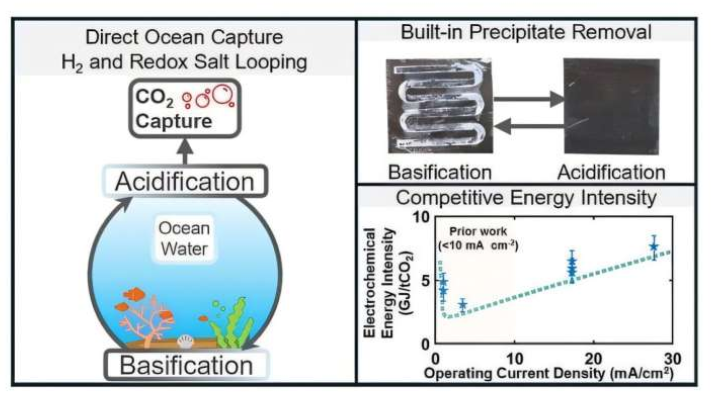
The new electrochemical process combines hydrogen gas and redox salt looping to capture carbon dioxide from seawater via controlled pH swings. To accomplish this, the device uses an ion-exchange membrane between two flow-cell compartments — one that carries seawater and the other that carries a redox salt.
 Environmental Science & Technology (2026). DOI: 10.1021/acs.est.6c06443
During the acidification phase, hydrogen gas is introduced to the seawater, lowering its pH to 4 while reducing the redox salt and producing electricity. The acidic water is then sprayed into a vacuum chamber, where the lower pressure causes the dissolved CO₂ to escape as bubbles for collection.
The seawater then returns to the cell for the basification phase, where the electrodes reverse polarity. The process uses electricity to raise the water’s pH to 10.7, regenerate the redox salt and produce hydrogen gas. The treated seawater is then allowed to rebalance with the atmosphere, naturally returning to about pH 8.1 while absorbing additional CO₂. The hydrogen and redox salt are reused in the next cycle, creating a closed chemical-looping process.
The team tested the technology in simulated seawater over four consecutive cycles, demonstrating its ability to clean itself and prevent fouling. After basification, magnesium and calcium deposits covered up to 42% of the electrode surface, but the following acidification cycle reduced coverage to about 7%, removing 86% of fouling without acid washing or downtime. This enabled the system to maintain consistent energy performance, unlike previous approaches that lost 67% of their performance by the fourth cycle.
To improve reaction rates, the team added angled 1 mm fins to the redox salt flow channels. The ridges stirred the liquid, improving salt delivery to the electrodes and enabling a flow rate of 50 mL/min and a current density of 100 mA/cm².
According to its developers, the technology promises to help balance grid demand while capturing ocean CO₂. However, scaling it requires overcoming mineral buildup, slow salt transport and high electrical resistance.
The prototype still has electrical resistance about 100 times too high for practical deployment. The team plans to use metal outer plates and a near-zero-gap design to reduce resistance. At scale, the technology could capture carbon, help combat ocean acidification and provide grid-balancing services by shifting electricity use away from peak-demand periods.
The process is detailed in the article, “Effective Precipitate Cleaning with a Reversible Flow Cell Sustains Stable Energy Intensity for Oceanic CO₂ Removal,” which appears in the journal Environmental Science & Technology.