MIT engineers ditch the joysticks for smarter excavator control
Marie Donlon | August 26, 2026A team of engineers from MIT has developed an intuitive controller for excavators.
The controller mimics a miniature excavator arm and bucket, allowing operators to move it like a real excavator. Their movements are simultaneously mirrored by a digital excavator in an immersive six-screen virtual environment.
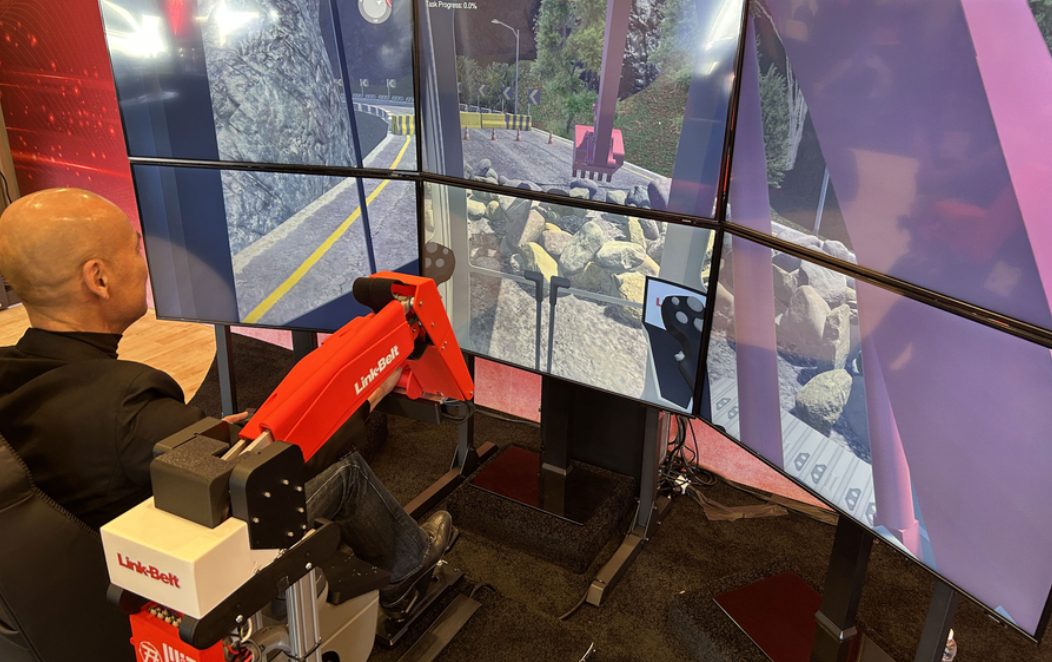 Source: MIT
This new excavator interface aims to make machine operation more intuitive by replacing traditional joysticks with an arm-like controller. The system could reduce the mental mapping operators need to learn, thus expediting training and making excavators easier to operate. It could also allow for remote operation, enabling workers to control machines from a safe location when working in hazardous environments.
Excavator operators are typically trained by driving real machines on controlled courses. During this process, they must learn how joystick inputs correspond to the movements of the excavator’s arm, bucket and cab, while coordinating those controls to complete assorted tasks. Developing this mental connection can take months or even years to perfect.
To reduce the learning curve, the team developed a more intuitive alternative to traditional joysticks. The mechanical arm closely resembles an excavator’s own arm and bucket, allowing operators to control the machine’s movements more naturally and reducing the need to mentally translate joystick inputs into physical actions.
Combined with software that mirrors the controller’s movements in a virtual excavator simulation, the mechanical design creates a new training and control platform for excavator operators called the World-Space Interface (WSI).
“‘World-space’ refers to everything in the world that is outside of yourself, or in this case, outside of the excavator’s cab,” the researchers explained. “Normally, operators have to build a mental map of how to manipulate things in the world-space. But now, we can just mime picking up rocks or dirt, and the computer will do that translation to the world-space for us.”
The team tested their World-Space Interface (WSI) in virtual excavation environments and discovered that new operators performed as well as experts from the start, unlike with traditional joystick controls, where trainees initially struggled. Volunteers trained for one hour a day over seven days on increasingly difficult excavation tasks across 15 realistic settings.
The team is now adding haptic feedback to let operators physically feel resistance when performing tasks.
The MIT team suggests that the arm-based system could offer a more intuitive alternative to joystick-based simulators, potentially allowing new operators to become productive faster and enabling more natural remote control of excavators.