Catalyst cuts green hydrogen production cost
S. Himmelstein | August 13, 2026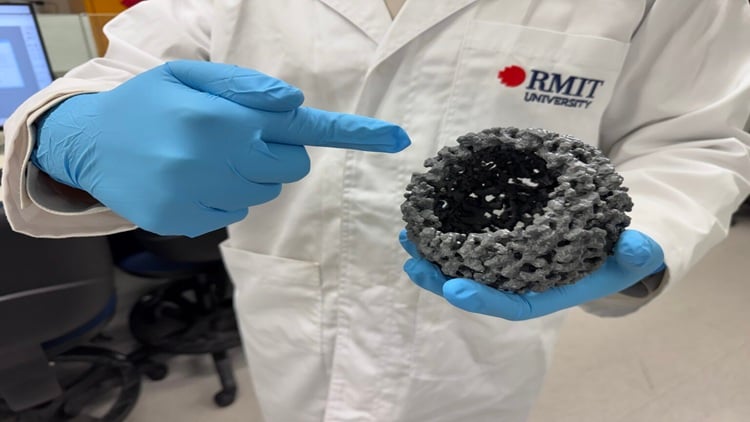 A model of the low-cost material and the precursor material used in the study. Source: Will Wright, RMIT University
An opportunity for enhancing the energy efficiency of green hydrogen generation via photocatalytic water splitting has been advanced by researchers from Zhoukou Normal University (China), RMIT University (Australia) and Xinyang University (China). The process is based on the use of an upgraded titanium dioxide (TiO2) catalyst to optimize the adsorption and activation energy of water, offering a low-cost path to increased hydrogen evolution.
The TiO2 nanosphere catalyst was engineered through a series of targeted modifications including the addition of nickel atoms, the introduction of defects that help guide how energy moves and shaping the material into tiny hollow spheres to better capture light. These changes allow the system to hold onto energy longer than materials currently deployed in photocatalytic systems and direct it to where hydrogen is formed.
Laboratory tests described in Applied Catalysis B: Environment and Energy confirm that the improved system produced significantly more hydrogen than standard versions of TiO2 catalyst, particularly when exposed to ultraviolet light. The production of green hydrogen increased by more than 80 times compared to the use of an untreated commercial version.
As a result of this finding, high-performing hydrogen production systems may be able to eliminate reliance on expensive precious metals such as platinum. “This work shows that comparable performance can be achieved using low-cost, widely available materials, which is critical if hydrogen production is to scale up,” said the researchers.