New polystyrene blends 50% plant-based materials with smarter recycling potential
Marie Donlon | November 19, 2026A research team led by the Institute of Functional Materials for Sustainability at Germany’s Helmholtz-Zentrum Hereon has developed a more sustainable version of polystyrene that incorporates bio-based raw materials and can be chemically broken down at the end of its life cycle.
Conventional polystyrene is used in a wide range of applications, including protective packaging for televisions and electronic devices, interior construction baseboards and petri dishes. Derived primarily from crude oil, the plastic is typically resistant to environmental degradation.
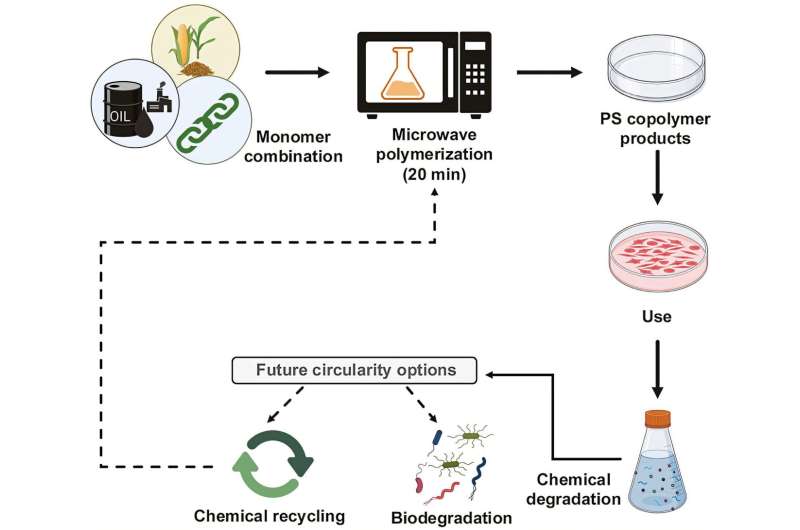 Source: Chem Circularity (2026). DOI: 10.1016/j.checir.2026.100163
The researchers developed the alternative by combining styrene with itaconic anhydride, a compound that can be derived from the fermentation of plant-based carbohydrates such as sugar. The resulting material contains roughly 50% bio-based raw materials.
To reduce energy consumption during production, the team used microwave radiation to heat the materials instead of relying on conventionally heated reaction vessels.
Another key ingredient, dibenzo[c,e]oxepane-5-thione (DOT), introduced built-in breaking points within the polymer network. These points allowed the material to be chemically broken down into smaller fragments at the end of its life cycle, offering a potential pathway toward more sustainable plastic disposal.
"Unlike conventional polystyrene, our material can be fragmented into small pieces," the researchers explained. The smaller fragments can undergo further chemical processing or be metabolized by bacteria, unlike conventional polystyrene, whose structure resists bacterial degradation.
"The new polymer was developed according to the design-for-degradation principle, meaning it is engineered for controlled breakdown at the end of its service life," the researchers added. "This opens up a pathway for polystyrene toward closed material cycles and a circular economy."
In the lab, the team used conventional injection-molding equipment to create miniature petri dishes.
An article detailing the material, “Microwave-assisted polymerization of degradable polystyrene copolymers toward circular single-use plastic,” appears in the journal Chem Circularity.