Smart coating could help tackle radioactive wastewater contamination
Marie Donlon | July 20, 2026A smart coating that promises to make tritium removal from nuclear power plant wastewater easier has been developed by researchers from China’s Soochow University in Suzhou.
The team sought to devise an approach for removing tritium — a radioactive form of hydrogen — because it is challenging to remove from wastewater. This is because it binds directly with water molecules, creating tritiated water, which mimics the behavior of actual water.
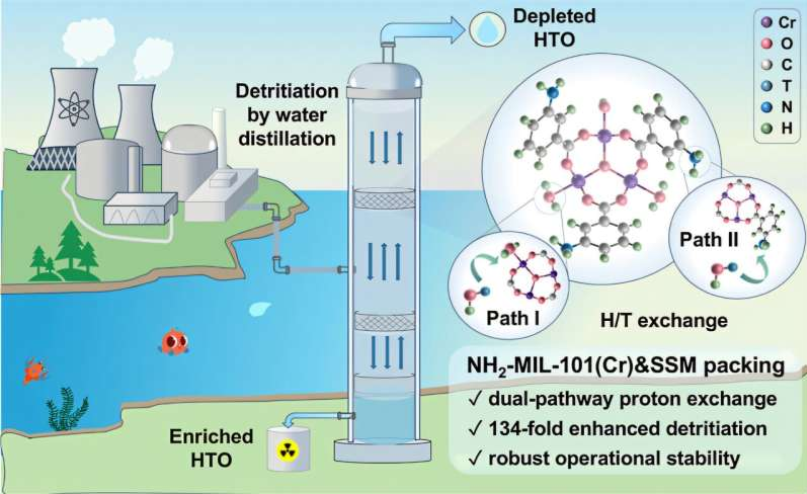 Source: Environmental Science & Technology (2026). DOI: 10.1021/acs.est.6c03906
Current tritiated water removal approaches rely on energy-intensive distillation, which requires large towers filled with passive metal mesh packings that offer surface area for vapor-liquid contact but do not actively enhance the separation process.
However, the team of scientists has developed an active packing material. Specifically, the team took standard stainless-steel mesh rings and coated them with a metal-organic framework dubbed NH2-MIL-101 (Cr).
According to the researchers, the coating increases the packing surface area by 32 times and enhances tritium-hydrogen exchange, thereby significantly improving distillation efficiency. In lab tests, the coated packings delivered high separation performance and remained stable for more than 22 days.
An article detailing the coating, “Dual-Pathway Catalytic Proton Exchange in Water Distillation Enables Record Detritiation of Tritiated Water,” appears in the journal Environmental Science & Technology.