Tunable Membrane Switches Between Oil or Water Removal
S. Himmelstein | May 30, 2018A versatile, reusable membrane can be configured to remove oil from water in wastewater treatment or oil spill cleanup applications, or to allow water removal from fuel. The smart mesh can be switched from oil to water removal by activation of a conventional alkaline battery for a few seconds.
Available separation membranes can selectively allow either oil or water to pass through them, but their switching ability is usually imparted by a toxic, short-lived chemical coating that may require days to activate and high voltages, corrosive solvents or other unfavorable stimuli or conditions to function. Separation efficiency is less than optimal -- oil and water of relatively low purity are often produced.
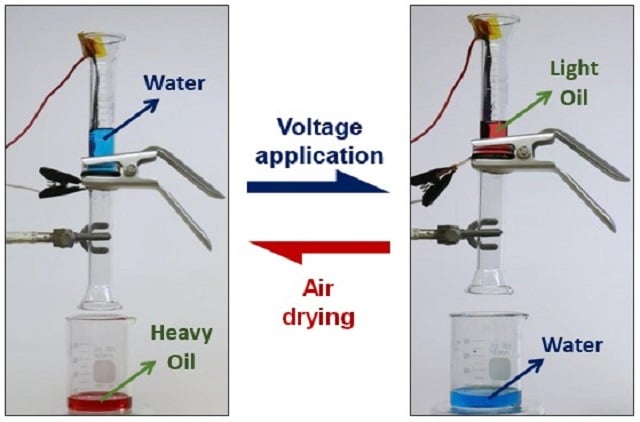 When a mixture of heavy oil and water is poured onto the membrane, the heavy oil flows through while the water does not (left). When a mixture of light oil and water is poured and a small voltage is applied, water flows through while the light oil does not (right). Source: University of British Columbia
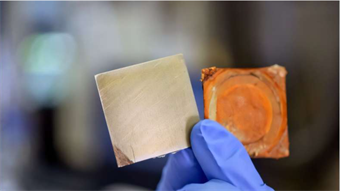
The additive-free, electrochemically treated copper mesh developed at the University of British Columbia performs such separations with more than 98 percent efficiency. The device changes from super oil-loving and water-resistant to super water-loving and oil-resistant in seconds. The membrane returns to its original state after air-drying.
Material preparation is described as a quick, scalable process, entailing the immersion of copper mesh in an electrolyte solution followed by exposure to small voltages for two minutes. The finished membrane possesses a tunable wettability ascribed to the multiscale roughness of the mesh structure and the copper oxides that are bound to it, which transform into water-loving metallic copper when voltage is applied.
Separation efficiency was maintained during 30 consecutive separation cycles conducted with light and heavy oils.