With aero-propulsive coupling, airframe and engine are integrated from the start
Andy Tomaswick | July 01, 2026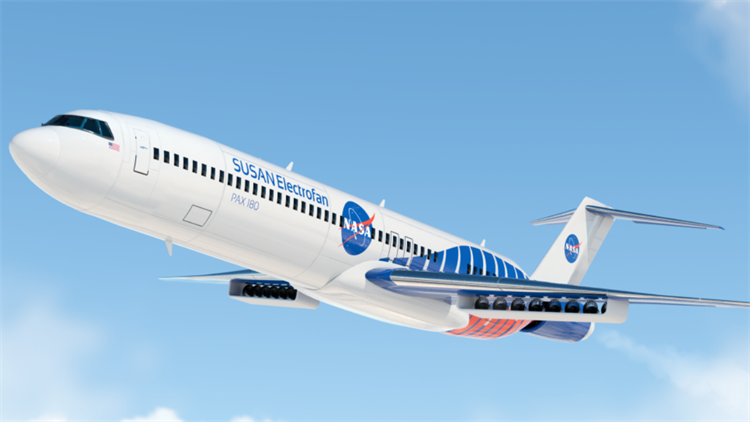 Source: NASA
Reducing energy demands and emissions is the largest engineering challenge in the aerospace industry today. Companies and researchers across the sector are trying to tackle this issue from as many angles as possible. Hybrid-electric aircraft, sustainable fuels and new aircraft designs are great examples.
However, many approaches have treated two of the biggest influences to the fuel efficiency of the vehicle - the airframe and propulsion systems - as separate aerodynamic systems. The podded engine approach – the term for a gas turbine engine and integrated nacelle assembly – has hit the upper limit on efficiency gains.
To surpass those limits, aerospace engineers are turning to a technique known as aero-propulsive coupling. In this design philosophy, engineers integrate the airflow physics of the vehicle airframe directly into its propulsive mechanisms.
One leading example of this effort is the 180-passenger hybrid-electric subsonic single aft engine (SUSAN) electrofan currently under development at NASA. SUSAN isn’t intended for commercial use any time soon, but instead will serve as a test bed for electrified aircraft propulsion (EAP) systems that enable propulsion-airframe integration (PAI) technologies. Specifically, two of those technologies are critical to SUSAN: distributed electric propulsion (DEP) and boundary layer ingestion (BLI).
The mechanics of DEP
In the world of turbofans, bigger has been better up to this point. Larger fans increase efficiency by increasing the bypass ratio, meaning they increase the percentage of air that goes around the turbo fan rather than through it. This creates a much quieter system and provides steady thrust at cruising speeds. But it comes with tradeoffs.
Larger turbofans mean more weight and also increased drag, since they typically hang off the underwing of the plane. As they get larger, the aircraft also needs taller, different landing gear configurations.
To deal with some of these trade-offs, engineers have turned to DEP, which is a network of distributed, small, wing-mounted duct fans instead of two massive turbofans. In the SUSAN system, for example, there are 16 individual smaller fans, referred to as DEP-125 propulsors. Each fan handles only around 4% of the overall thrust of the plane, so they can be designed with significantly lower fan pressure ratios. Doing so increases the fan’s efficiency, thereby directly reducing the amount of power required to produce a given level of thrust. Weight also scales with the square of diameter of a rotating propulsor, so by utilizing an array of smaller fans rather than two enormous ones, the total mass of the system decreases.
However, DEP is not a silver bullet. Since there are more fans, there’s an overall increase in the wetted area, or the parts of the system that are exposed to air flow. Increased area means increased drag, so the ultimate tradeoff in DEP systems is whether the reduction in shaft power can outpace the friction drag penalty incurred by increasing the number of fans.
Reclaiming wake energy with BLI
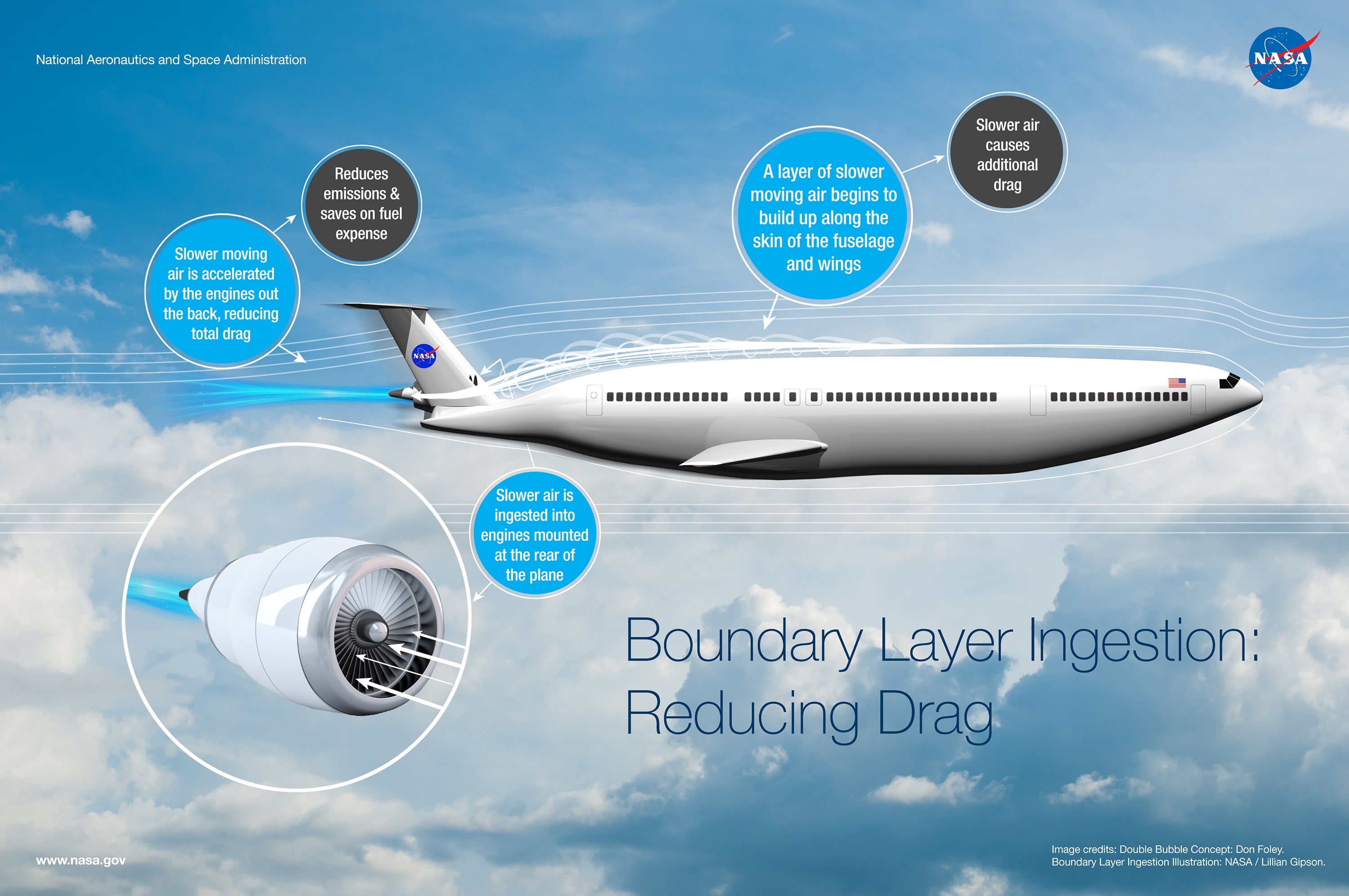
In a conventional aircraft design, the engines are strategically placed to ensure clean airflow and maximize efficiency. But aircraft with BLI turns this logic on its head.
On BLI planes, the turbofans are mounted directly on the fuselage and the engine is designed to ingest air that has lost momentum due to skin friction along the fuselage. By taking in the slower-moving air of this boundary layer, the aircraft doesn’t have to fight as much ram drag, or the drag by high-speed air as it enters and slows in an intake. In order to produce a positive net thrust, it must overcome the force of that ram drag. Since ram drag is directly tied to the incoming speed of the air, lowering that speed makes turbofans located in this position much more efficient.
Notably, this boundary layer air is non-uniform, creating imbalances in the forces on the fan. The immediate effect of these imbalances is to severely impact fan performance, but over the long run it can also impact the fan integrity and overall life cycle of the turbomachinery. So as with DEP, the design trick is striking a balance. The best way to understand how to is by modeling it, often with computational fluid dynamics (CFD).
 Click to enlarge. Source: NASA
The path forward for propulsion and weight trade-offs
Traditional turbofan designs drive a fan directly from a turbine - there’s no conversion needed. But hybrid-electric systems take an additional step of converting mechanical energy into electrical energy. Even worse, they distribute that electrical energy to the individual propulsors and then convert that electrical energy back into mechanical energy.
Even modern-day electronics can’t make those versions 100% efficient, meaning they will introduce losses in the system. In some cases, these powertrain losses make it so that hybrid electric airframes actually become less efficient than the highly designed purely mechanical legacy aircraft. As a consequence, the whole value proposition of hybrid-electric propulsion comes into question.
But it’s not just the loss of electrical efficiency these designs can result in a significant increase in weight. They require generators, thermal management systems and cable harnesses, each of which contributes to the operating empty weight. That consequently directly translates into an increase in the maximum takeoff weight (MTOW). Keeping a heavier aircraft aloft at cruising altitudes requires more lift, which then induces a further drag penalty because of the redesigned wings. These sorts of vicious trade-offs are what make the design of different propulsion systems for aircraft so difficult.
The difficulty won’t stop engineers from trying, though. Technology developments are constantly being released that can help with all of these trade-offs. High energy density battery chemistries can lower the weight requirement of electrical systems. Increased efficiency power conversion electronics can directly impact the bottom line of electrically driven fans. As these technologies become more widely adopted, they will increase the interest in aero-propulsive coupling more generally.
There are still plenty of difficulties to overcome in the quest to decrease the emissions and fuel requirements for this critical worldwide industry. While the development of a truly new type of propulsion system will be fraught with challenges, it could still possibly provide one of the most effective paths towards dealing with those difficulties.
Don’t be surprised in the near future if you happen to see some planes with radically different designs coming to an airport near you.