Using clay to rapidly control severe hemorrhaging
Marie Donlon | March 06, 2026A team of researchers from Texas A&M University is using clay as a possible solution for extending the critical time frame — often referred to as the golden hour — before severe blood loss from an injury leads to hemorrhagic shock and, potentially, death.
A suite of injectable hemostatic bandages was derived from biomedical materials that halt bleeding and encourage blood to clot faster. The team focused primarily on deep internal bleeding wherein traditional methods such as compression are not possible. These clay-infused dressings can reportedly reduce bleeding time by almost 70%.
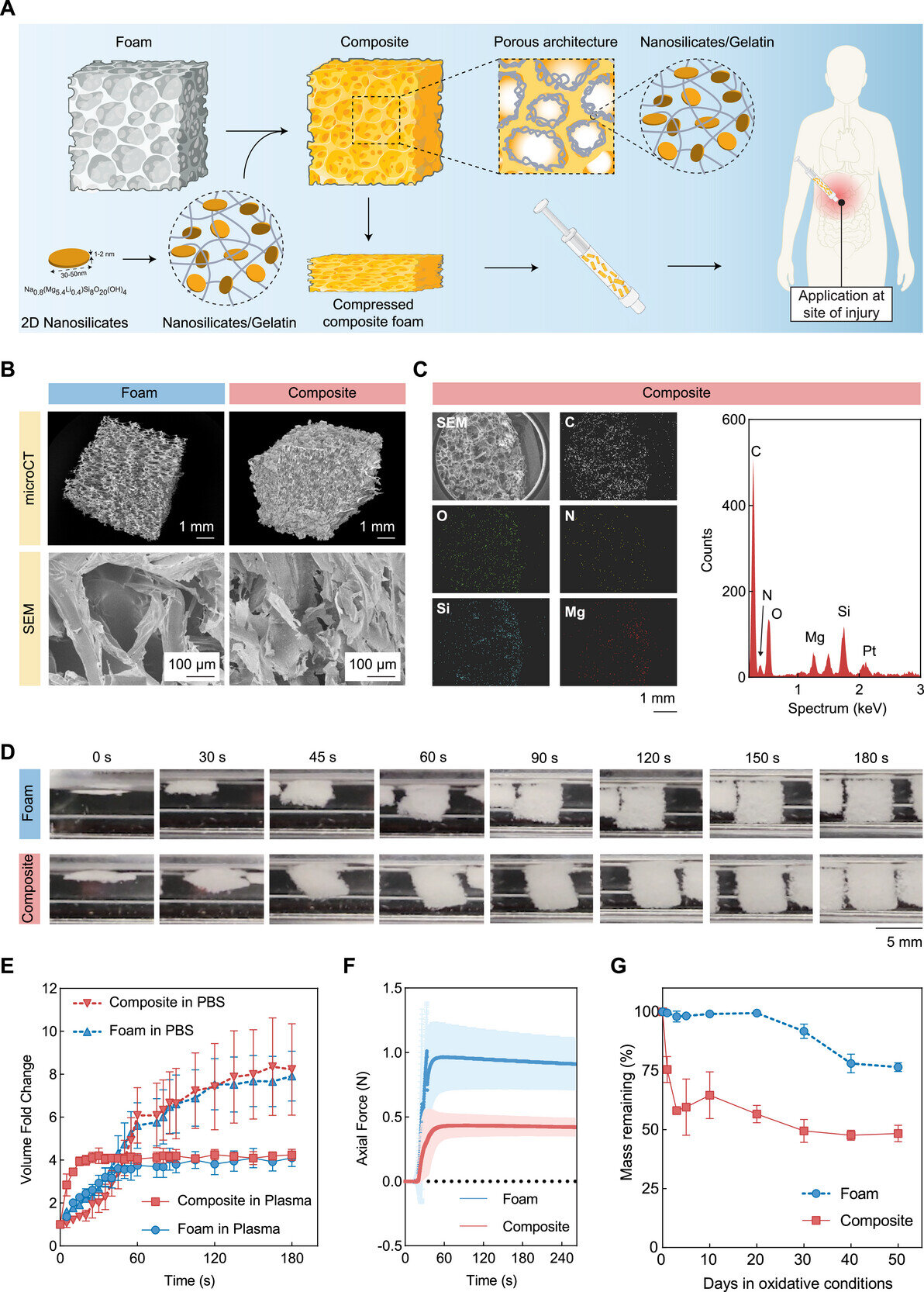 Source: Advanced Science (2026). DOI: 10.1002/advs.202508439
"Under normal circumstances, human blood clots within six to seven minutes," explained the team. "Using these hemostatic dressings, we are able to reduce the clotting time to one to two minutes."
The clay-infused dressings could prove to be a lifesaving device easy enough so that a critically injured person could apply it to themselves immediately following injury.
The team chose clay, which has been used for wound treatment for thousands of years, because certain naturally occurring clay minerals feature silicate-based particles that can expedite blood coagulation.
"These clay particles were being used as a hemostat in ancient civilizations in China, Mesopotamia, Egypt, India, Greece and Rome, likely owing to their absorbency and tissue adherent properties," the researchers explained. "Ancient peoples would make a paste out of water and clay particles and apply it to wounds to stop bleeding faster."
Inspired by the particle's blood clotting properties, the team examined the potential uses of a synthetic particle that would avoid the possible risk of infection that comes with natural clays.
The researchers first sought to address the challenge of getting this particle to the injury site and keeping it there because high blood flow tends to wash powders and pastes away. Beyond failing to halt bleeding, this presents another risk to the patient as the nanosilicate particles are small enough to travel through blood vessels to non-injured areas of the body, where they can cause life-threatening blood clots and embolism.
To combat this risk, the nanosilicate particles were combined with an expanding foam. Although the particle-laced foam is completely stable in its applicator device, it reportedly reacts to body heat, expanding once it is injected into a wound site. There, the mixture expands to fill up the entire space, subsequently sealing severed blood vessels and keeping the blood-clotting nanosilicate precisely in place. The team added that because the foam forms one single piece, the risk of particles breaking away and traveling to create dangerous blood clots in other areas of the body is eliminated.
Another approach used to prevent wound hemorrhaging involved micro-ribbons. Specifically, the team developed multiple ribbon-like structures, each covered in coagulation-promoting nanosilicate particles, to deliver the biomaterials.
Similar to the foam, the micro-ribbons rely on the patient's body heat to encourage a reaction once in place. The team added that each ribbon is comprised of two different materials: one that reacts to body temperature and another that doesn’t. Once the micro-ribbon is in contact with the patient's body, one side contracts and subsequently curls. With several ribbons curling at the injury site, they will tangle together, creating a single foam-like structure. Even in the event that a single ribbon was able to escape, the size of the structure would prevent it from traveling through blood vessels, keeping the blood-clotting nanosilicate precisely in place.
"If these materials get into the first aid kits in an ambulance as well as a soldier's backpack, they can save a lot of lives," the team concluded. "If you can save 30–40% of hemorrhagic shock victims, that is a big achievement."
An article detailing the bandages, “Expandable Nanocomposite Shape‐Memory Hemostat for the Treatment of Noncompressible Hemorrhage,” appears in the journal Advanced Science.