New role for physics in district heating
S. Himmelstein | February 24, 2026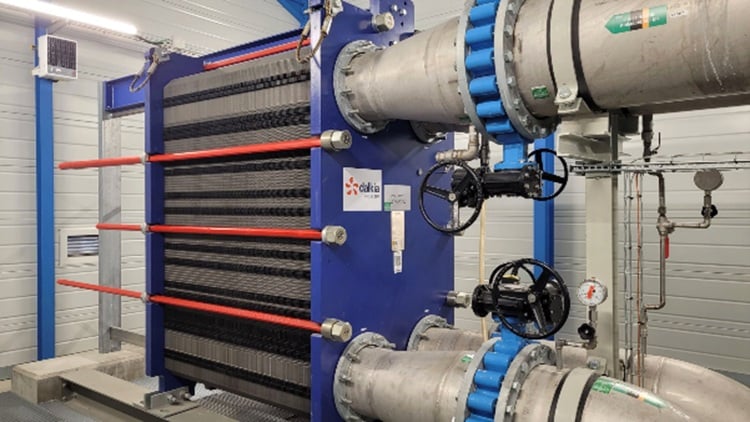 One of the two 5 MW heat exchangers at LHC Point 8. Source: CERN
The Large Hadron Collider (LHC), a system crucial for the study of particle physics, now has an additional mission. The world's largest and highest-energy particle accelerator, built by the European Organization for Nuclear Research (CERN) in Switzerland, now supplies heating to homes and businesses in the small French town of Ferney-Voltaire.
In its new role as a renewable thermal source, the accelerator harnesses the large quantities of heat generated during its operation and redirects it for use in district heating. The heat captured by water used to cool cryogenic components is typically passed through a cooling tower, releasing heat into the atmosphere. Now hot water first flows through two 5 MW heat exchangers at Point 8 in the 16-mile structure, which transfer thermal energy to the town’s district heating network. This output could potentially double when CERN is fully operational.
Similarly, CERN’s Prévessin Data Centre is equipped with a heat-recovery system set to warm most site buildings, and the future recovery of heat from LHC Point 1 cooling towers will warm buildings on CERN’s Meyrin site. These initiatives will save 25 GWh to 30 GWh per year as of 2027, marking significant progress in CERN’s responsible energy management.