Immediate, on-site detection uncovers food fraud
Marie Donlon | February 20, 2026Researchers from three Fraunhofer institutes are developing a mobile gas chromatography sensor system to help detect counterfeit food products, like olive oil.
According to its developers, the easy-to-use device is expected to enable non-experts to perform quick on-the-spot assessments.
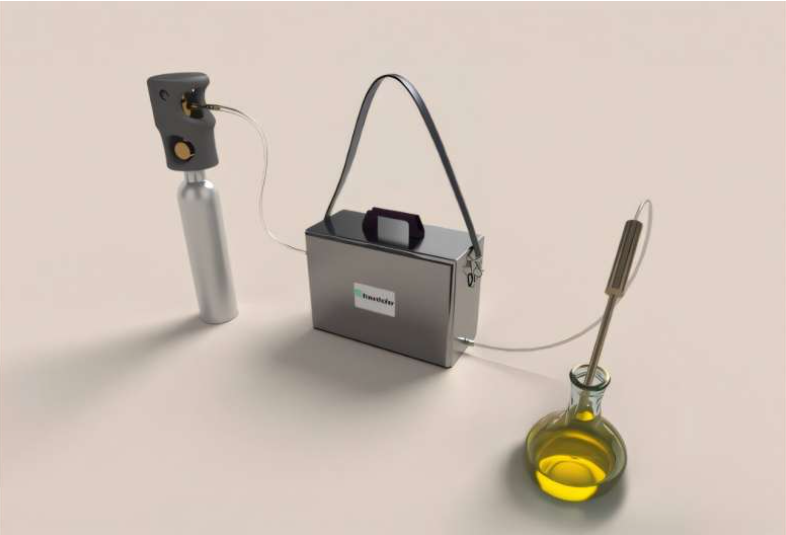 Source: Fraunhofer-Gesellschaft
Currently, detecting counterfeit foods requires expensive and time-consuming laboratory analyses and trained specialists tend to be necessary for operating the equipment and interpreting the data.
The new system — which is being developed by the research teams at the Fraunhofer Institutes for Photonic Microsystems IPMS, for Molecular Biology and Applied Ecology IME and for Process Engineering and Packaging IVV — is expected to result in a mobile gas chromatography sensor system for rapid on-site detection of volatile organic compounds (VOCs).
The team is targeting VOCs specifically because they are chemical compounds that reveal information about the makeup of a material, potential health hazards as well as signal changes in product characteristics. As such, VOC detection is critical in several fields, including food quality and safety, health care, civil security, agriculture and the chemical industry.
"There's a clear need for cost-efficient, rapid and robust on-site measurement technology that yields immediate results," the team explained. "Our system isn't universal, but its modular design makes it suitable for a broad range of applications. In the PUMMEL project, we're focusing on two industrially relevant use cases.
"First, the identification of counterfeit olive oil, which ranks among the top 10 most frequently falsified food products, and second, the detection of contaminated plastic recyclates that can accumulate in packaging materials. This is particularly significant given that the recycling rate reached a record high of nearly 70% in 2025. For this purpose, we're developing two application-specific demonstrators for VOC detection," the team added.
According to its developers, the proposed mobile system, which is expected to be roughly the size of a shoulder bag, will feature a silicon-chip-based gas chromatography (GC) column, a detector or sensor, integrated sample preparation, control and data-processing electronics along with a power supply.
“Gas chromatography (GC) is an analytical method used to separate, identify and quantify mixtures of substances. It's suitable for gaseous or readily vaporizable compounds that don't decompose on vaporization," the team explained. "A carrier gas first transports the sample through the GC column, which we've etched into a rapidly heatable and coolable silicon chip."
Gas molecules entering the column will interact with the polymer-coated inner surface, where VOCs react with the coating according to their affinity, thus enabling separation of the mixture. Further, located at the end of the chip-based GC column, a detector will measure the separated substances according to their molecular characteristics, producing a gas chromatogram featuring peaks that reveal the composition of the mixture. With olive oil specifically, the team would be tasked with determining parameters such as country of origin, age and purity level.
To make the device portable, the Fraunhofer researchers are working to create miniaturized GC columns that can offer sufficient separation of VOCs specific to different foods.
The team suggests that the device could eventually be used by non-specialists like bottlers and incoming-goods inspectors.