
Laser detection method could improve counterfeit alcohol screening
Marie Donlon | August 25, 2026A team of researchers from Adelaide University has developed a laser-based technology that promises to help authorities detect deadly counterfeit alcohol, wine fraud and dangerous chemicals sealed within unopened bottles.
According to the researchers, the new laser system is capable of detecting toxic methanol present within unopened bottles of alcohol — even through colored glass.
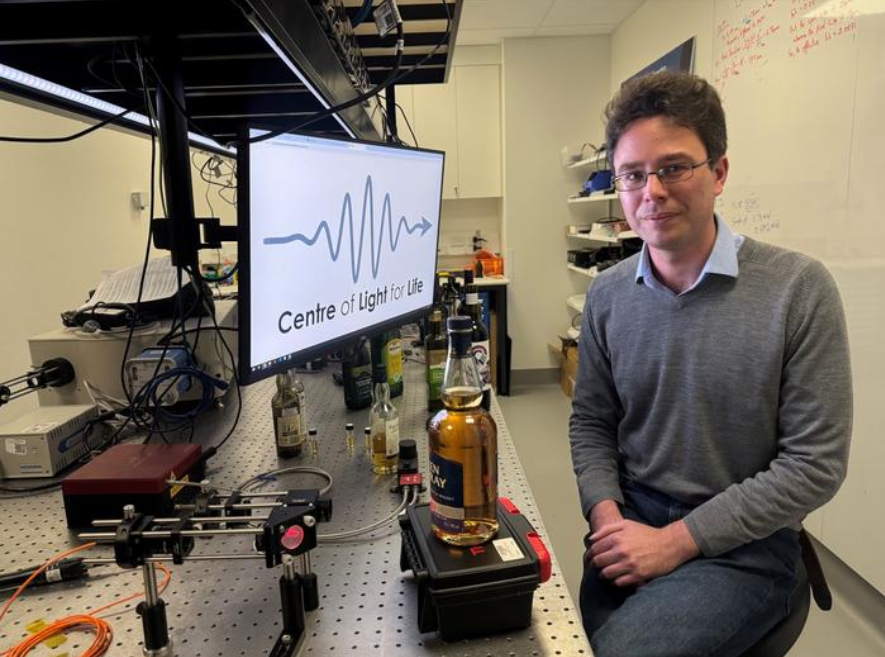 Adelaide University physicist Dr Ralf Mouthaan, one of the team members who developed the methanol detection technique. Source: Adelaide University
Methanol poisoning from counterfeit alcohol causes hundreds of deaths and permanent injuries each year, and the new optical technique could potentially detect fake alcohol without opening bottles or requiring costly lab tests.
To accomplish this, the team employed a form of sensing known as Raman spectroscopy, which enabled the researchers to read the unique chemical "fingerprint" of a liquid through its packaging.
To detect minute amounts of methanol while simultaneously filtering out interference from the bottle itself, the team combined two advanced optical techniques to carefully shape the laser beam and subtly change its wavelength during measurement.
In tests, the technology detected methanol at concentrations roughly 10 times lower than internationally recognized safety limits. Furthermore, the system offers a rapid, non-destructive alternative to current lab testing.
Beyond detecting methanol in bottles of alcohol, the Adelaide team suggests the technology could potentially be used for applications including wine authentication, food quality and product safety. Research is also ongoing to determine if the laser technology can be used to detect trace pesticide contamination in olive oil, identify counterfeit perfumes or enable law enforcement agencies to determine if suspicious bottles contain hazardous chemicals before they are opened.
The technology is detailed in the article, "Non-invasive Raman spectroscopy with wavefront shaping and wavelength modulation to quantify methanol in bottled spirits," which appears in the Journal of Physics: Photonics.

1