Plastic preferred as solar hydrogen photocatalyst
S. Himmelstein | February 27, 2026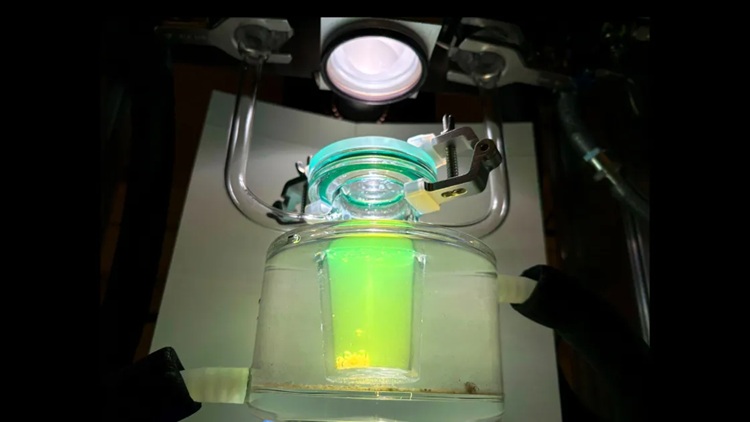 Hydrogen bubbles to the surface during photocatalysis in the laboratory. Source: Chalmers University of Technology
Hydrogen is emerging as a valuable contributor to renewable energy supplies and is typically produced by the use of platinum photocatalysts. However, reliance on this metal incurs economic and environmental costs in addition to supply chain issues. To counter these drawbacks, an international research team turned to a commonplace, low-cost commodity to demonstrate a lower carbon footprint approach to solar hydrogen generation.
Instead of pricey platinum, electrically conductive plastic — also known as conjugated polymers — can be applied to significantly lower process costs in place of platinum, dramatically reducing economic burden of solar hydrogen production. These polymers absorb light efficiently but are typically less compatible with water, prompting the researchers to modify the material’s properties by means of the nanoprecipitation technique so that it self-assembles as nanoparticles in water.
As reported in Advanced Materials, laboratory trials used a lamp to simulate sunlight and demonstrate the process. Vitamin C served as a sacrificial antioxidant to prevent the reaction from stalling, as confirmed by the immediate formation of hydrogen gas bubbles in water. The gas was collected and guided through tubes to a storage container, with the volume of gas monitored in real time. Just a small amount of conjugated polymer material is needed to deliver significant quantities of hydrogen: the test yielded 209 mmol g/hour of hydrogen, and without the use of platinum.
Researchers from Chalmers University of Technology (Sweden), Uppsala University (Sweden), Karlstad University (Sweden), Changzhou University (China), Harbin Institute of Technology (China), and the University of California-Santa Barbara contributed to this development.